Archive | Observations and musings RSS feed for this section

Happy

3 May

It’s now three months that I’ve been ‘living the dream’, as my ex-colleague Mark would put it, by which I mean I’ve ditched the office job and I am splitting my time between writing and looking after my baby niece. I realised from the start that it’s a great change, but I hadn’t realised quite how great until I met up with my friend Andy in Edinburgh.

I was in the capital to do a bit of interpreting, which I do very occasionally, and arranged to meet Andy on the way home, since it had been a while – such a while, in fact, that I hadn’t seen him since he got married, and he hadn’t heard about my book. We had a nice wee ice creamwith his new wife, sitting in Princes St Gardens  (my knowledge of Edinburgh isn’t great so I have to meet people in obvious places), and afterwards Andy commented on how happy I seemed. It took me a moment to work out what he meant.

The thing is, you see, that I used to meet Andy for a coffee after meetings in Edinburgh that were part of my office job, so I would spend the entire time moaning about my job, and he would spend far less time moaning about his job, because he is a kind and patient person. This time, we talked about books and theology and Andy’s job, but the usual topic of conversation was completely absent. I hadn’t noticed, but Andy had.

My current job is not all fun. The niece can be hard work, deadlines are stressful, there are a lot of things to juggle, and sometimes it’s a real chore to make myself sit in front of the computer and write. But these are legitimate challenges of an occupation – a career – I actually enjoy. I can contemplate the future with optimism rather than dread. I am, in short, happy.


You can buy Leda and (Office Life and Death) on Amazon – or wherever else you choose.
EK OK

17 Feb

I’ve spent most of the last few days in East Kilbride, and it felt like a very long week. East Kilbride, or EK, is a town outside Glasgow. It has an older ‘village’ section (so I’m told) but most of it is post-war, with more than its fair share of block-like 60s monstrosities of architecture and civil engineering. The town centre is composed of a large shopping and some car parks.  EK is ugly, there’s no way around it.

On top of that it has its own micro-climate, which is awful. If it rains in Glasgow, it sleets in EK; if it snows in Glasgow, EK is snowed-in for months and has to survive on tinned sardines; and it is always blowing a gale. I exaggerate, of course, but honestly, the weather is terrible. And while you are fighting your way through the elements you always seem to be going uphill, because flat roads are as rare in EK as sunny days.

This is why my few days in EK were quite trying – this, and the fact that hills and weather seem worse when you’re pushing a pram at an hour when you would rather be on bed. But what this week has also shown me is why East Kilbride is such a popular place to live – and it is; the town is full of new housing estates because people are falling over themselves to move there.

Mainly its that housing is cheaper here than in Glasgow, but it’s easily commutable. It’s not just that, though. I have found people here to be friendly and helpful, perhaps even more than in Glasgow. The town is sympathetically laid out for pedestrians, as well as motorists: footpaths cut up, down and across every hill, making handy shortcuts and safer walking. Even the hideous (and imaginatively named) East Kilbride Shopping Centre is an asset when you consider the weather outside.

And in the station just now, as I was writing this, a woman exclaimed “Jesus Christ!”, a man remonstrated “Excuse me – that’s the name of the Lord”, and the woman, instead of giving him a filthy look or a mouthful of worse language, simply apologised. How many places would that happen? East Kilbride may be physically ugly, but in other ways it’s no eyesore.

Jane Austen vs. Food Poisoning

19 Jan
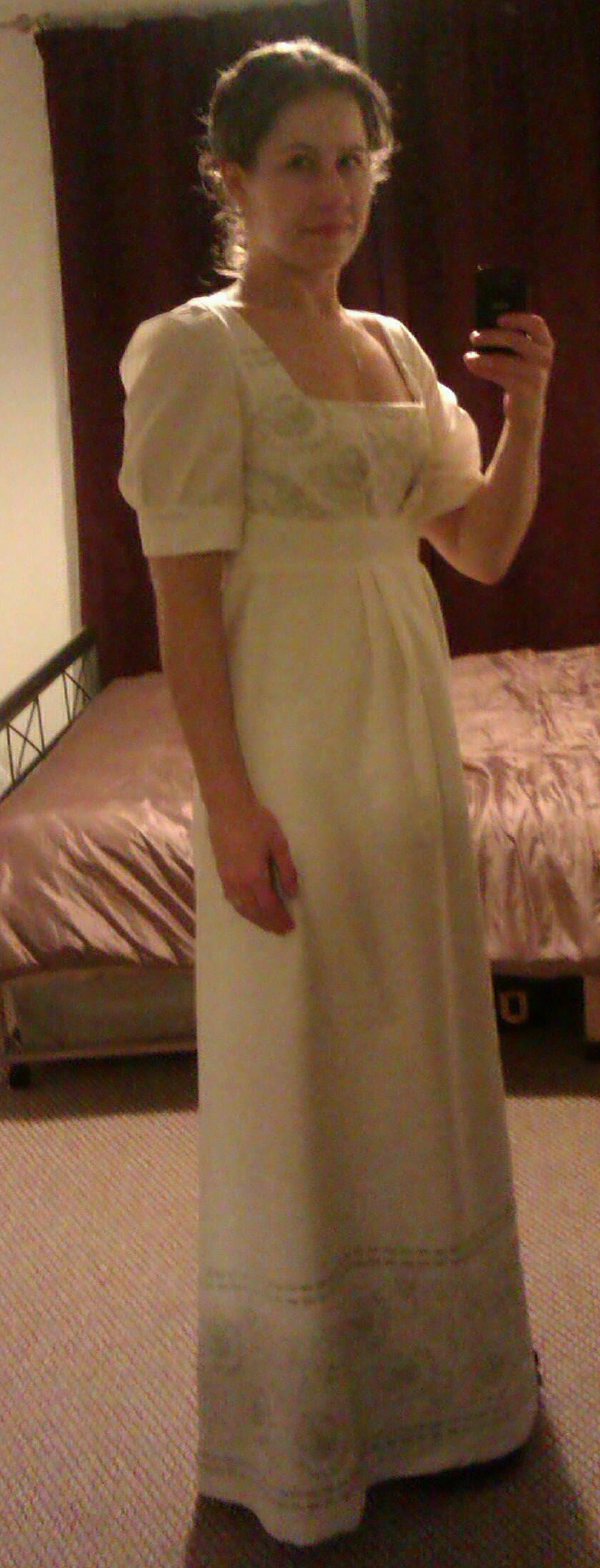
Jane Austen-style dress

Just call me Jane Bennett.

I’m sure the world will be relieved to know that, after a truly horrible bout of food poisoning, I am now able to eat again and don’t have to survive entirely on Lucozade.  Ok, that’s not interesting at all, nor pleasant to think about, but the reason I mention it is this: I suspect that I may have eaten the offending item at a Jane Austen ball at the weekend. There was a buffet, which vastly increases the chances, and the timing would work out.

The ball was held for a friend’s 21st birthday, and it was wonderful, with period dancing (including the one that Elizabeth dances with Darcy in the BBC’s Pride and Prejudice, which bizarrely enough is called Mr Beveridge’s Maggot), period card games (although we gave up on quadrille and played Irish snap instead, except that we called out “quadrille” instead of “snap”) and people dressed up in Regency costumes.  I wore a dress that I made for the occasion (see photo) and was so proud of the outcome. In short, it was a once-in-a-lifetime party and I had a fabulous time.

So here is the quandry: how much suffering is worth it for a once-in-a-lifetime party? On the first day of food poisoning, while writhing on my bed of sickness, I thought, “Ah, but I wouldn’t take back my decision to go, despite the consequences!” On the second day I thought much the same thing. By the third day I was no longer writhing but still couldn’t really eat and felt about as hale and hearty as a wet dish rag – and my conviction wavered. So was it worth it or not?

I’m sure in time I’ll think it was – I’ll have fond memories of the party, may still even have some of the friends I made there, and the ghastly few days will be just a footnote. But now, in the cold light of recency (which I think is a word), what’s the verdict? I have to say I’m really not sure. But if I can break the rules of this little dilemma and make it a trilemma (which definitely isn’t a word, although it’s a handy one), if I could do it all again I would go to the ball, but would merely admire the beautiful buffet from a distance.

Scrabble

28 Dec

I’m just back from a family Christmas.  One of the things that makes Christmas christmassy is playing board games.  You never look at one for 11 months of the year, and then, when there finally is (usually) something decent to watch on the TV, you dig them out.

This year it was Scrabble.  I was up against a Scrabble ace (she claims her neices always beat her – they must be world champions) and two teachers, including an English teacher.You’d probably expect me to hold my own at Scrabble, given that, as a writer, words are the tools of my trade.  It turns out Scrabble isn’t like that, though; it’s all about tactics.  I had played the game before, but too long ago to remember properly, and I thought it was all about coming up with long words.  It’s nothing of the kind.  It’s coming up with anything that is a real word, provided you land on a double / triple score square.  My best score (30-odd) came from adding two letters to make “it”, “in” and something else with an i, while my longer words struggled to score in double figures.  I came last in the first game, third in the second, and won the third, albeit with a lot of heavy hints from the Scrabble ace.

The most interesting thing to my mind, however, was not who won (although I wasn’t completely indifferent), but the way being observed by your competitors makes you unsure about how to spell the simplest of words, or even they are words at all.  The dictionary flew round the room as if we were playing pass the parcel, as people checked whether “cog” started with a c, and if “id” is a real word.  (It is, but meaning a part of personality, opposite to ego, rather than short for “identification”.)

It’s a good job we only played three games, otherwise my confidence would have deteriorated so far I would never have been able to write another blog post again!

Fact Checking

6 Dec

I experienced a wee bit of disappointment reading The Cross of Christ the other day. It’s not that it failed to be insightful or that I thought the opinions in it were invalid, it was a ‘fact’ contained on p368.

The author, John Stott, cites a Paul Tournier citing another man called Pierre Rentchnick, talking about the effects of being orphaned on a man’s psychology. He gives a big long list of examples, including Hitler, Stalin and Napoleon, but starting with Alexander the Great and Julius Caesar. Now I know off-hand that Alexander was no orphan. He could only become king because his father had died, obviously, but that was when he was 19 and very much an adult. His mother, Olympia, used to write him long letters when he was off conquering the world. (One day I will, I promise, write a piece about Alexander for my ‘Ancient History – just the best bits’ series, but it’s daunting because it’s impossible to do him justice.)

I quickly checked up on Julius Caesar too, and his father died when Julius was 16 and just about to enter public life, which I don’t think counts, either. He, too, was to all intents and purposes an adult in that society.

It’s not important, or course – one small fact wrong, and who knows who even made the original mistake with all that citing going on, but it made me think: How often have I relied on someone else’s work, blithely citing them and assuming they’ve checked? How often have other writers built on shaky foundations this way? Not a comforting thought.

By the way, Stott also uses the word ‘authoress’, which is so dated I’d never even heard it before. My new word for myself? 😉

An Advent Ambition

27 Nov

Today is the first day of Advent. You may recall that, way back in Lent, I started reading John Stott’s magnum opus The Cross of Christ. I did read it for the whole of Lent but didn’t finish it. After that, life got in the way, other things were more urgent, and I was only getting through it at a pace that would have embarrassed a snail.

The approach of Advent changed that. I am now determined to finish it by Christmas, and you can hold me to that. I’m already in the final section, about how it applies to real life, so it shouldn’t be too hard. Tomorrow I will be starting on the thorny problem of the authority of the state from a theological point of view. It’s heavy stuff, but I think it’s fairly appropriate as we prepare to celebrate that other great theological mystery – the Incarnation – at Christmas.

(By the way, in the time that I’ve been reading his book, Dr Stott has died. All the more reason to make good use of what he left behind, I think.)

Constant Corriecraving, or The Awkwardness of Almost Strangers

18 Nov

I have a problem. It doesn’t blight my life but it does create regular moments of social awkwardness. I pass the same guy on the way to work most days, and sometimes on the way home, too. I don’t know him, I know nothing about him, but obviously I recognise him since I’ve seen him several times a week for years. You’d think we’d have struck up an acquaintance over the years. We haven’t. In fact we are condemned to what the Meaning of Liff dictionary would call ‘corriecraving’, without the relief of ‘corriedoo’.

It’s not just him, though. There are all the people who wait at the same small station as me every morning and get the same train to the same destination. I know most of them by sight but etiquette demands that I pretend not to, and we are only permitted to talk to each other when the trains are disrupted.

I once broke this law. In a fit of high spirits after receiving some good news I cheerily wished one of my fellow passengers good morning. Did this break the ice? Did I then have a companion to greet each morning? No, it just made things worse, because then I had to see this incomplete stranger every morning with the added awkwardness of knowing that I had once wished him a cheery good morning. Luckily for me, he soon moved away.

As for my corriecraving companion, that problem should soon be solved, too, since I’m leaving that place of work. Not because of him, of course, but it won’t be one of the things I’ll miss.

The Hidden Dangers of Freebies

24 Oct

This morning as I walked out of the station in the herd of other commuters, I spotted people huddling under a brightly coloured beach umbrella, handing something out to passers-by. This is not an unusual occurrence; at least once or twice a year there are people handing out freebies at rush hour. I’ve had chocolate bars, drinks, and even a Gillette razor. This time it was a bottle of Powerade Energy, berry flavour. I took one and made my cheery (yes, that’s sarcastic) Monday morning way to work. I had a quick squiz at the ingredients as I was opening it – natural flavours, caffeine, vitamins and serious-sounding minerals, no doubt designed to do you lots of good. Fair enough. It wasn’t until halfway through the morning, and halfway through the bottle, that I noticed all the health warnings: Not suitable for children. Not suitable for pregnant women. Not suitable for those sensitive to caffeine. Not intended to be consumed in high quantities. Ulp! The point of the drink is to provide energy for high-intensity activities – so of course a bunch of desk-bound commuters are the ideal candidates. The drink was quite nice, I have to say, and if it weren’t for the dire warnings, maybe I would have drunk it again. As it is, though, I’ll probably stick to something safer – like lighter fluid.

Grey Hair

7 Oct

What is this new fashion for young girls dying their hair grey or white?  At first I thought I was seeing dye disasters, where it was supposed to have come out blonde or black or purple even, but had unfortunately gone wrong.  Then I saw more teenagers with these colours  and my mother (my mother!) told me that it is a real fashion.

There was once a fashion for grey or white wigs (17th – 18th century I think), but I was always led to believe that it happened in a time when age was venerated.  Now we live in a youth-orientated culture where 30 is considered past it – so why the grey hair?  It does actually look ok on some people (grey does – white just makes people look dead) but it also makes them look like some terrible trauma has turned them grey before their time.

Not being a teenager, I’ve started getting white hairs myself, and naturally the mind turns towards whether or not to dye.  I don’t think I’ll be dying the rest of it to match, though.

National Niceness

8 Sep

Racism is bad. We know this. Few attitudes are less socially acceptable. However, there is a form of racism which does seem to be acceptable, to society at large and to the ‘victims’: positive national stereotypes. The idea that Scots are good with money, Germans are punctual, the English have a great sense of humour. An Irish person might well object to being labelled stupid or hot-headed because of their nationality, but would they really mind if people think they know how to party?

The reason my mind is on this train of thought is that I had to make a phone call to Canada to check a reference for my new lodger. Calling complete strangers, it might have been awkward, but instead we had a cosy chat, and if it hadn’t been a phonecall we would probably have ended the conversation with a hug. The point is this: Canadians are nice. Has anyone ever met a nasty Canadian? (I may have done, but I can’t remember if she was Canadian or American, so she’s not a very good counter-argument.) Perhaps I should keep an eye out in future to see if I meet any Canadians, or members of other nations, who counfound or confirm their national stereotype.

As for me, a canny Scot, am I good with money? Well, after negotiating my latest contract with Orange (£39 reduced to £10.60), I’m feeling pretty canny at the moment.