The Selfish Giant’s Square

7 Feb


I have taken to avoiding Blythswood Square as I make my way around Glasgow. I used to deliberately travel through the Square if I was in that part of town, because I liked the walk through the tiny park / garden that lies in the middle of it. That was before they locked it up. Now it just depresses me to have to walk around it and see the padlocks and notices.

The official reason given by the notices is the Occupy protestors who set up a measly camp of three tents in one part of the park in November. It was a pretty uninspiring protest, and they must have been freezing. I thought in the end they’d been blown away by the storms (literally or metaphorically) but it turns out that they were actually blown away by a court injunction. To prevent anything like that happening again, the notice said, it has been necessary to close the park. Thus, the actions of a “selfish few” have spoiled it for everyone.

That doesn’t wash. Leaving aside the motives of the campers (a “selfish” anti-greed campaign? Hmm), the situation now is that there is a five foot (or so) fence on a small wall, finished with four padlocked gates. That would hardly keep out determined protestors for two minutes – I could scale it myself if I was so inclined – but it will keep out office workers and passers-by, who were the people who used the square.

The main reason I find their notice disingenuous, though, is that the fence started going up long before the protestors arrived. As soon as they rebuilt the fence it was obvious where things were headed, and the big gates confirmed it. When the protestors moved in it gave them an excuse, but it does appear that they were planning to close the park anyway.

I keep saying “they” and “them”. The park is owned by the surrounding businesses, as I understand it, so it is private property and the owners are within their legal rights to close it. However it is also the only patch of green in the surrounding area, and is enormously popular with office workers who walk through or around it in winter, and lie on it having picnic lunches in summer. (“Summer” here meaning the few sunny days that we get in Glasgow.) For years and years it has been a much-loved local amenity and has had its litter collected and flower beds planted by the council. Now, probably at the behest of the Bythswood Hotel (because that is the big new business in the Square), it’s just another small pleasure that’s being denied to ordinary people, possibly because we make it look messy.

I have fond memories of sunny times spent in the park Blythswood Square garden, eating ice cream, sunbathing and chatting. The notice on the locked gates says that the garden will still be opened on sunny days in summer. I hope that’s true, but it’s not much of a consolation. It’s not just me who liked the place, either; according to the survey of Living, Working and Spirituality in Glasgow, 24% of people gave an outdoor space as their favourite place in Glasgow City Centre, and many of them specifically mentioned Blythswood Square.

Blythswood Square park used to be a little bit of green pleasure in the middle of a working day. Now it’s just the Selfish Giant‘s garden.

The End of a Chapter

31 Jan

I have given up the day job; today is my last day at the office. Although I’ve spent as long there as I did at university, neither the job nor leaving it feels momentous in the way matriculating and graduating did. In my head it was always a temporary job, you see, despite evidence to the contrary.

In fact it’s not strictly true that I’ve given up the day job. Really I’ve just swapped it, since I will now be looking after my beautiful baby niece a few days a week. But not only is this part time, giving me more time to concentrate on writing, babysitting is also more conducive to writing than an office job – especially during her two hour nap. Even when she’s awake she’s wonderfully portable, and can come with me if I need to meet someone or even go to the library. I’ve found a baby opens doors, both in the literal sense (you’ve really got to watch her) but also with booksellers.

So now I really have to commit myself to my writing career, and the uplifting but also scary truth is that I can nevermore say I didn’t have a go. I’ve left safe predictability behind, and I may crash and burn, but you never know – I may discover I can fly.


Copies of Leda Available

25 Jan

At long last I have many paperback copies of my children’s novel Leda in my possession. Of course, I would like to have fewer copies, so please do buy it. Copies are available from me or direct from the publisher, Troubador.

It will soon be available in a number of bookshops in Glasgow, and I’ll let you know on Leda‘s page which are stocking it, once it’s confirmed. There will be book signings too – again, details will follow.

(It will be more generally available after May because that’s the official release date.)

Jane Austen vs. Food Poisoning

19 Jan
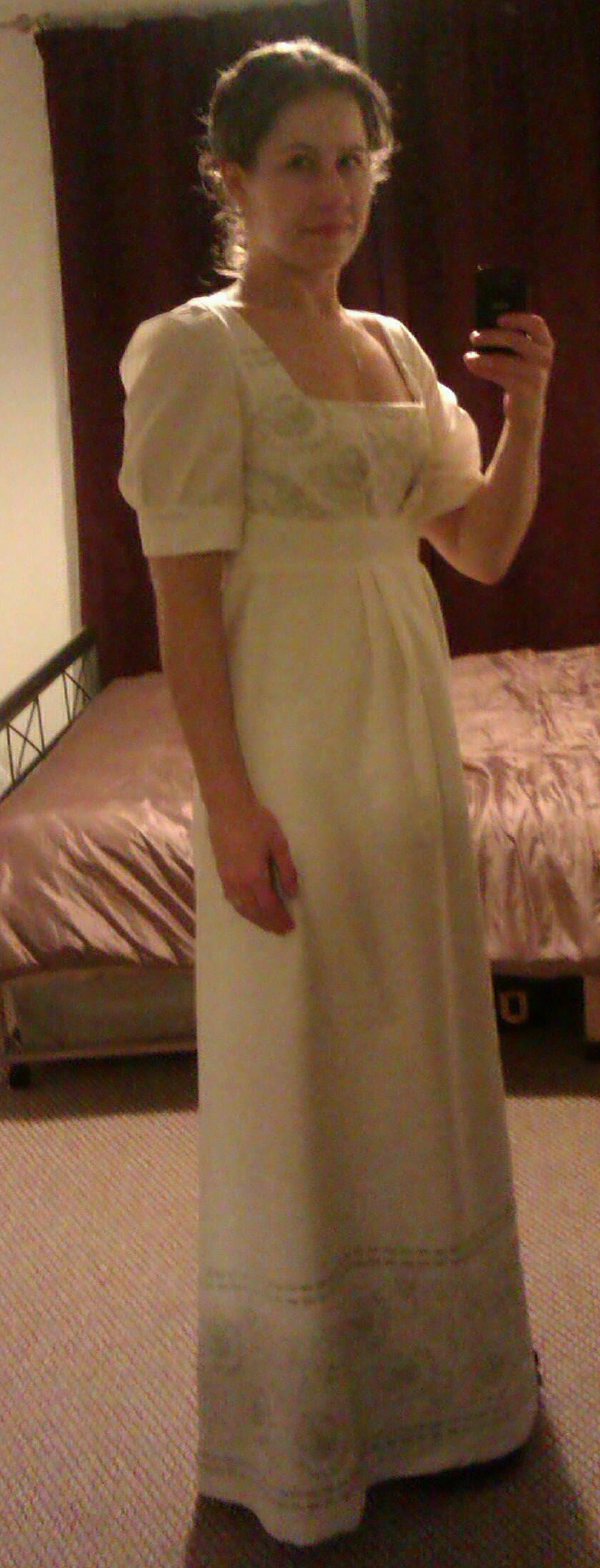
Jane Austen-style dress

Just call me Jane Bennett.

I’m sure the world will be relieved to know that, after a truly horrible bout of food poisoning, I am now able to eat again and don’t have to survive entirely on Lucozade.  Ok, that’s not interesting at all, nor pleasant to think about, but the reason I mention it is this: I suspect that I may have eaten the offending item at a Jane Austen ball at the weekend. There was a buffet, which vastly increases the chances, and the timing would work out.

The ball was held for a friend’s 21st birthday, and it was wonderful, with period dancing (including the one that Elizabeth dances with Darcy in the BBC’s Pride and Prejudice, which bizarrely enough is called Mr Beveridge’s Maggot), period card games (although we gave up on quadrille and played Irish snap instead, except that we called out “quadrille” instead of “snap”) and people dressed up in Regency costumes.  I wore a dress that I made for the occasion (see photo) and was so proud of the outcome. In short, it was a once-in-a-lifetime party and I had a fabulous time.

So here is the quandry: how much suffering is worth it for a once-in-a-lifetime party? On the first day of food poisoning, while writhing on my bed of sickness, I thought, “Ah, but I wouldn’t take back my decision to go, despite the consequences!” On the second day I thought much the same thing. By the third day I was no longer writhing but still couldn’t really eat and felt about as hale and hearty as a wet dish rag – and my conviction wavered. So was it worth it or not?

I’m sure in time I’ll think it was – I’ll have fond memories of the party, may still even have some of the friends I made there, and the ghastly few days will be just a footnote. But now, in the cold light of recency (which I think is a word), what’s the verdict? I have to say I’m really not sure. But if I can break the rules of this little dilemma and make it a trilemma (which definitely isn’t a word, although it’s a handy one), if I could do it all again I would go to the ball, but would merely admire the beautiful buffet from a distance.

Leda Available on Kindle

10 Jan

My children’s novel Leda  has just been released as a Kindle ebook.  You can download it from Amazon.  The paperback edition will be available directly from me (or the publisher, Troubador) in a few weeks, or on Amazon in May.

For more details, see Leda‘s page.

Norn Arn

6 Jan

Nuala with the Hula, Belfast (Ardfern)

I spent New Year in Norn Arn. For anyone who doesn’t know, that’s Northern Ireland in a Northern Irish accent. Alternative spellings are Norn Urn and Norn Iron. It was my first time in that part of Britain, so I thought I’d record my impressions, for what they’re worth.

The thing that struck me most was the different attitude to personal space. It’s not that people crowd you, it’s just that don’t have that automatic impulse to move aside when someone else comes too close or tries to get past. Weaving my way to the toilet after church I had to push through knots of people who didn’t seem the least bit awkward about it. When I got to the other side I realised that part of the reason it was so crowded was that a third of the room was empty; people were huddled like emperor penguins.

In some ways Norn Arn is a lot like Scotland, but a notch or two up: the weather is terrible, worse than Glasgow; the people are very hospitable and keep plying you with food; and they seem to have the same sort of humour when it comes to giving nicknames to landmarks – the Balls at the Falls and Nuala with the Hula, for instance.

In other ways it’s nothing like Scotland, or like my part of it anyway – hence the fact that we were at church bright and early on New Year’s Day when all sensible people are in bed. The church was lovely and the sermon was inspiring, but I couldn’t get over the fact that every pew was full at 10.30 on New Year’s Day.

The day I returned (the day before the big storm, fortunately, or I wouldn’t have been going anywhere), we went to Belfast, the capital. Belfast seems like an odd mixture of Dundee and Prishtina (which is not meant as an insult – there’s nothing wrong with Prishtina). Up close it’s much like every other major city, apart from the amazing profusion of craft shops. You will usually find one or two in a city, though you’ll have to search for them, but in Belfast they’re dotted all over the city centre. There’s even a shop dedicated to beads.  So I suppose if I ever do get stuck in Belfast because of the weather, there will at least be plenty to keep me occupied.

Of Caves and Monsters

31 Dec

Something a little arcane to end the year: an unimportant little theory that I’d like to share, namely that the decor of Tiberius’ dining-room-in-a-cave at Sperlonga was influenced by Etruscan tombs.  If that means nothing to you, I won’t be offended if you don’t read on.

(By the way, the date should be on this, but just in case, for referencing purposes it is 31st December, 2011.)

Dinner at Sperlonga

The first and only time I was in Aberdeen, I remember looking for a place to have lunch and stumbling across a Frankenstein-themed bar.  The decor was dark and gloomy with plenty of chains, and the menu was full of dishes and cocktails which referenced vampires, zombies, and monsters of all kinds.  It seemed to be a fairly popular place, with the student population especially.

It’s not only Scottish students who see the appeal of dining with monsters.  Domitian and Hadrian both gave pride of place in the grotto triclinia (dining rooms) at their villas to scenes of Scylla consuming her own personal menu of Odysseus’ sailors.  They lifted the idea from the most famous grotto triclinium at Sperlonga, the same cave where, in 26AD, Sejanus saved Tiberius’s life when the roof came down during dinner.

The Sperlonga sculptures, discovered in 1957, are a gift to ancient historians and art historians, not only because of the quality of the four sculptual groups (Scylla attacking Odysseus’ ship, the blinding of Polyphemus, the theft of Palladium, and Odysseus with the corpse of Achilles) but because they provided what a historian loves best, controversy.  Starting with what the statues depicted (since they were found in pieces), and progressing to where they were placed, who placed them there, why and when, the discovery of the statues sparked years of learned arguments, some of which are not settled even now.  There is still no consensus on the date of the statues to within less than a century.

The link with Tiberius is a given – it was the grotto at his villa, after all.  But whether he put the statues in before the rock fall, as a background for his dinner parties, or afterwards, when the cave seemed more sinister to him, is not as easy to answer.  A major argument for the statues’ being placed in the caves after the accident is that scenes of people being eaten and monsters being blinded is not appropriate to decorate a dining room – “not while we’re eating, thank you.”  Grottoes, including grotto triclinia, were supposed to be peaceful places where nymphs frolicked with Dionysus.

That might have been the Greek conception of caves, but across the Adriatic Sea caves had a different place in mythology and in the psyche.  For Etruscans and other natives of Italy, caves were the place where the living world met the underworld.  In beautifully decorated tombs such as the Tomba dell’ Orco you find monsters like Cerberus and Polyphemus and celebrity shades like Agamemnon and Ajax, in scenes both Homeric and non-Homeric.  Demons of the underworld and the god of death occur frequently in these late Etruscan tombs.

It all sounds rather intimidating and would have no bearing on the question of the Sperlonga statues, except for one other feature of Etruscan tombs, probably the most common of all: banqueting scenes.  Too many tombs to mention feature scenes of symposia, either with mourners honouring the dead or with the dead enjoying themselves in the underworld.  These feasts by no means always appear in tombs that also feature monsters and violence, but there are certainly incidences where they do.  There seems to be no contradiction, in the Etruscan mind at least, in having a party, complete with dancing girls and plenty of wine, within sight of hideous and frightening monsters, and of reminders of their own mortality.

If the Sperlonga grotto  followed the Etruscan / Italian conception of the role of caves, the argument that the statues wouldn’t be appropriate for a dining room looks pretty weak.  The influence of the other peoples of Italy on Roman culture is so completely accepted that it doesn’t bear mentioning.  The civilisation that gave Rome the gladiatorial games for which the modern world now remembers them, may well have also bequeathed the idea of a connection between caves, feasting and death, and allowed for the development of dark, monstrous grotto triclinia.

This kind of dining room chimes well with Tiberius’ character, of course, which probably lent itself more to scenes of graphic violence than to frolicking nymphs.  This was an emperor with a nasty streak a mile wide and a disposition that would make Gordon Brown look sunny.  So the triclinium at Sperlonga was probably a stylish (though none too safe) place to bring friends for a dinner party not in spite of the scenes of violence and monsters, but because of them.  Add a few aptly-named cocktails and the students of Aberdeen might feel right at home.

Scrabble

28 Dec

I’m just back from a family Christmas.  One of the things that makes Christmas christmassy is playing board games.  You never look at one for 11 months of the year, and then, when there finally is (usually) something decent to watch on the TV, you dig them out.

This year it was Scrabble.  I was up against a Scrabble ace (she claims her neices always beat her – they must be world champions) and two teachers, including an English teacher.You’d probably expect me to hold my own at Scrabble, given that, as a writer, words are the tools of my trade.  It turns out Scrabble isn’t like that, though; it’s all about tactics.  I had played the game before, but too long ago to remember properly, and I thought it was all about coming up with long words.  It’s nothing of the kind.  It’s coming up with anything that is a real word, provided you land on a double / triple score square.  My best score (30-odd) came from adding two letters to make “it”, “in” and something else with an i, while my longer words struggled to score in double figures.  I came last in the first game, third in the second, and won the third, albeit with a lot of heavy hints from the Scrabble ace.

The most interesting thing to my mind, however, was not who won (although I wasn’t completely indifferent), but the way being observed by your competitors makes you unsure about how to spell the simplest of words, or even they are words at all.  The dictionary flew round the room as if we were playing pass the parcel, as people checked whether “cog” started with a c, and if “id” is a real word.  (It is, but meaning a part of personality, opposite to ego, rather than short for “identification”.)

It’s a good job we only played three games, otherwise my confidence would have deteriorated so far I would never have been able to write another blog post again!

Cwrtnewydd Scribblers Anthology 2011 – A Way with Words

20 Dec

The Cwrtnewydd (no, I can’t pronounce it either) Scribblers Anthology, A Way with Words, has just been released, and it contains my short story “A Recipe for Summer”, which is very good, if I say so myself, and nothing like as twee as it sounds.  The anthology has sold out its first print run but they’re doing another.  Check out the Cwrtnewydd Scribblers homepage for updates.


Update: This anthology is now available as an ebook on Amazon priced at 77p. And it turns out Cwrtnewydd is pronounced court-NEW-with.

Advent Ambition Achieved

19 Dec

I have finally finished John Stott’s magnum opus, The Cross of Christ, and very good it was too. The final chapter was rather surprising, too. Meanwhile, I managed to wolf down two books by Jeff Lucas, because his stuff is considerably lighter than Stott’s (and I don’t think he would be offended by my saying so).

They were called Helen Sloane’s Diary and Up Close and Personal: What Helen Did Next. They deal with the everyday tribulations and frustrations of a twenty-something Christian singleton. Any resemblence to Bridget Jones is entirely deliberate. The first book was absolutely amazing. The second wasn’t as good, and at first I thought it was going to be a real let-down, but it got going after a shaky start. The first one was still much more fun and, importantly, more believable as well. I would thoroughly recommend it – not just for Christians, but also for anyone who wants to know what the day-to-day business of being a Christian and a real person is like.

My favourite quotes from Helen Sloane’s Diary:
“I can’t pull off skinny jeans. Well, more accurately, I can’t pull on skinny jeans – not past my knees, anyway.”
(about a flag-waver in church) “I’ve read that the army of God is terrible with banners. She’s terrible with a banner.”

I saw at the end of the book that Jeff Lucas has a blog. “Great,” I thought, “more of his ascerbic yet helpful wit!” No, just a list of when he’s appearing and where he has appeared on his book tour. He might be surprisingly good at writing the inner life of a 27 year old woman, but he’s not quite caught up with the modern world when it comes to the definition of a blog.