Archive | Observations and musings RSS feed for this section

Life’s a Beach

14 Aug

I’m not long back from my latest excursion to Albania. I didn’t spend as long as usual this time, just the three weeks (I know, your heart bleeds), but I did find some time to get away to the beach while I was there, and thought I would give a quick impression of the differences between British beaches and Albanian ones (or Mediterranean ones more generally). If you’ve spent time at both and know all this already, feel free to skip, but if you’ve never experienced the sweaty hedonism of a Mediterranean beach, or the chilly exhilaration of a British beach, read on.

Seagulls

This was the thing that got me thinking about the differences to start with. I was lying on my lounger (of which more later) in Spille, reading This Must Be the Place, when I heard what I thought was a seagull crying. In Scotland, this sound is so ubiquitous at the coast, and even in cities, that you don’t register it, but when I heard it on that beach I suddenly realised it was the first one I’d heard. So I looked up to see – a man selling squeezy horns for kids to play with, along with other toys and games.

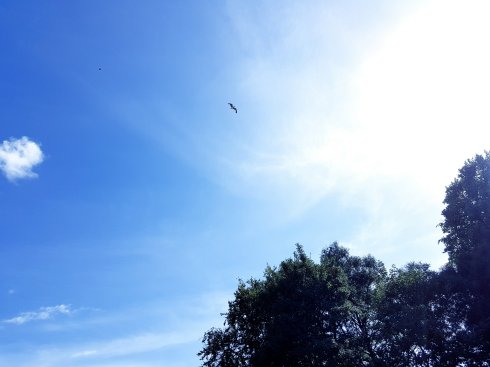
A seagull doing its thing

In Scotland, and the rest of the UK, seagulls hang above the seaside like stringless kites, ready to dive-bomb anyone who is too careless with their chips. At Spille, the avian background music was provided by peaceful wood pigeons, or duduftu (brilliant piece of onomatopoeia).*

Vendors

If you harbour dreams of being waited on hand and foot, or fondly imagine that you were Cleopatra in a former life, Albanian beaches might be for you. You can turn up with just your towel and your swimsuit, and people will come round selling you everything else you need, including on beaches where this is explicitly prohibited. Here are some of the items that will come to you, if you wait long enough:

  • Doughnuts
  • Playing cards
  • Novelty horns (see above)
  • Newspapers
  • Bananas
  • Cold(ish) drinks
  • Sets of dominoes
  • Candy floss
  • Inflatables
  • Buckets and spades
  • Corn on the cob

Some of the more touristy beaches even have massage and hair braiding. No one seems to sell novels though, so bring your beach read with you. In Britain for sale actually on the beach you will find:

  • Donkey rides

And that’s about it. That’s not to say you won’t find plenty to eat and drink and amuse yourself near the beach, but there’s pretty much nothing on it. There’s a reason for that, and it’s the same reason that lies behind point 3:

Sun loungers

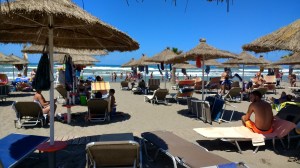
Shezllone in this picture is not the name of a place, it is the Albanian word for sun lounger, which they have clearly borrowed from the French. (Say it out loud and see if you can work it out.)**

Albanian beaches, and Mediterranean beaches in general, are covered with pairs of sun loungers arranged in neat rows, usually with an umbrella complete with mini table. There are obvious advantages to this system: you don’t get nearly as sandy, the sand doesn’t blow over you, you’ve got shade without having to hoik an umbrella around with you, you’ve got somewhere to put your drink and hang your clothes, etc.

The disadvantage is that these loungers belong to someone, usually to the adjoining beachfront hotel or café, and you have to pay to use them. If you don’t want to, you’ll struggle to find an unused bit of beach to lay your towel on. Being a bit lazy, especially when it comes to carrying things in hot climates, I like the shezllone system, but I understand why it wouldn’t work in Britain. Even if we did have enough hot weather to justify permanent beach furniture, there’s a very good reason why nothing is left on the beach overnight, which is…

Tides

On our second day in Spille, it was very windy (though still hot) and this meant that the sea was full of waves. My mother-in-law thought that made it very unsuitable for swimming and was a bit concerned when I went in, but for me it brought back memories of holidays as a kid, jumping over small waves and body-surfing the big ones (and ending up with lots of salt water in my nose). This is because the coast in Britain is full of waves all the time, whether it’s windy or not, because we have tides.

It’s one of those things that feels unrealistic, like the water running down the plughole in the opposite direction in Australia (allegedly; I’ve never been). When you’ve grown up with a sea that advances and withdraws by hundreds of yards twice a day, it just doesn’t feel safe to leave your sandals right next to the water, even though you know they’ll be just where you left them when you come out. I have a vivid memory of seeing my clothing float past me at Southport, even though we had all left our clothes way up the beach. It’s hard to get used to the calm, stationary Mediterranean, with its more-or-less stationary waterline.

It’s easy to get used to warmth, though. Sometimes even the Mediterranean seems too cold to me these days, and I grew up paddling in the Atlantic, and even went swimming in the North Sea at five in the morning. I have become nesh.

Kids

My final observation is really a reflection of wider Albanian culture, not just beach culture. Kids go everywhere, at every time of day. There were kids on the beach in the blazing heat of noonday. If they got crotchety (as you would expect) the solution was to put them down for a nap, tucked under a sheet – on a sun lounger in the blazing heat of noonday. This would not be recommended practice in Britain, to say the least.

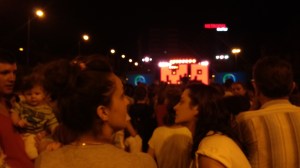
But kids go everywhere and sleep anywhere in Albania – including music concerts. In the photo above you may be able to see small children and babes in arms at the Maratona e Këngës (Song Marathon), which started at nine in the evening. “Are all the bairnies in their beds? It’s past eight o’ clock” does not ring true in Albania. In theory they should all be suffering terrible developmental problems due to the haphazard sleeping patterns, irregular meals, excessive exposure to TV etc. But in reality they seem to turn out fine, so maybe they’re doing something right.

Anyway, now it’s back to late summer in Scotland for me, which in practice means cold and rain. It’s been excessively hot on the Continent and, as is often the case when that happens, it’s been unusually cold and miserable here. So no one will see my beautiful tan because I’m wrapped up from head to toe all the time. But if you bump into me, do feel free to compliment me on my wonderfully bronzed hands 😉


*  Please don’t give me any of that rubbish about seagulls not being a real thing. They’re gulls. They live by the sea. They’re seagulls, alright?

** Chaises longues

The Art of Complaining

3 Apr

“I couldn’t sleep a wink!”

One of the joys of helping to look after my little nieces is getting to revisit things from my childhood. Last week it was paperchain people (try them with monkeys – it’s really cute!) but the week before that it was the Princess and the Pea, the Hans Christian Andersen story about a girl who arrives at a castle in a storm, claiming to be a princess, and whose royal pedigree is proved by her feeling a dried pea through 20 mattresses.

Coming back to this story many years on, instead of dwelling on how ridiculous this is (and it is), I instead found myself thinking, “Of course complaining about a pea in her bed shows she’s a princess. If she was a nice, middle-class girl she wouldn’t dream of complaining!” I mean really, if you were taken in on trust, out of a storm, alone and helpless, would you tell your host the bed was lumpy? I wouldn’t lie about it, but I’m sure I could find something more positive to say than, “I couldn’t sleep a wink all night!”

This got me thinking about complaining more generally. In Britain, we’re traditionally not supposed to be very good at complaining. To be more accurate, we’re very good at moaning about things, but we would rather die than complain to anyone who can do anything about it, like a waiter or shopkeeper, for example. Perhaps we might write a stiff letter, but never say anything to anyone’s face.

This is a Very British Problem, judging by the Twitter account of the same name, which is extremely funny. (It’s also available in book form for those who aren’t into social media.) This is also one of the areas where I’m not very British, perhaps as a result of spending too much time overseas (or it could just be my personality). I am fairly likely to complain if something isn’t right. I spent 15 minutes in Superdrug the other day trying to return some hair chalks that only cost about three quid, on the principle that if you buy something, it should work. The complaint has been forwarded further up the chain of management. By the time I get my three quid back (if I ever do) they will probably have devalued to the equivalent of 30p due to Brexit.

Maybe I shouldn’t have bothered. But there are some things you are supposed to complain about, or at least not sit on. I often find I’m annoyed by some insignificant thing someone has done again and start thinking, “He/she knows I hate it! They’re doing it to annoy me!”, only to realise that I’ve probably never told them I hate it, and they are blithely oblivious to my irritation. In a situation like that you either have to say something, or learn to live quietly with the annoyance, rather than explode in rage when it happens for the tenth time.

Addictions are another situation where you’re supposed to complain, according to official advice. Without going into any detail, there are some addiction/dependency ‘issues’ in my own family, and while a public blog post isn’t the place to drag them out, it’s not something I keep from my friends. In such a situation, silent forbearance probably makes things worse. But there is probably a level of willingness to complain that lies somewhere between doormat and drooket fairytale princess, which is healthy and practical without being self-centred. With that in mind, here’s a slightly altered version of the well-known Serenity Prayer:

God grant me the serenity to shut up about the things I ought to put up with,
The courage to complain about the things I ought not to,
And the wisdom to know the difference.

(If you’re into Hans Christian Andersen, by the way, check out my lovely audio version of the Snow Queen, narrated by Sophie Aldred.)

The Moral Importance of Foundation Garments

23 Dec

foundation-garments

It’s 23rd December, Christmas-Eve Eve, so naturally you would expect me to be writing about Christmassy things. And I was going to, honest. I even had the title worked out, “It wouldn’t be Christmas without…”. But then I got a new bra.

Yes, I know, that’s too much information. But it is relevant because it got me thinking about the (albeit not immediately obvious) similarities between brassieres and moral codes.

It’s been a while since I’ve had a new bra, and ages since I had an expensive, good-quality one, and I had forgotten how much of a difference it makes. The thing about elasticated undergarments, and moral codes, is that over time they have a tendency to grow slack. They are less restrictive, but also less supportive.

I noticed an astonishing difference as I ventured out into the world wearing my spanking new purchase. Some clever engineering goes into these bits of frippery; I felt positively cantilevered! I noticed that I held my head higher, and my shoulders straighter, too, the structured nature of my unmentionable reminding me of other areas that could do with a bit of improving, like posture.

On the first day of wearing the new nether-garment it did feel restrictive and unfamiliar, but by the second day it had become natural, to the extent that when I come to wash it, and have to wear one of my old ones, I will probably miss the new rigour.

I’m never one to leave an analogy unstretched, so bear with me as I opine that moral codes are not dissimilar. (By the way, if the language is more flowery than usual, the glass of rioja I just had seems to have gone right to my head.) Moral codes, like bras, have a tendency to loosen and stretch, without our necessarily noticing. They seem fine, but it’s only when you compare what they are supposed to be like that you notice how much things have slipped.

There was a comment on the Premier website* under an article on three-parent babies to the effect that in-vitro fertilization used to be controversial, particularly for Christians, but now nobody bats an eye. A comment in reply pointed out that this is exactly the point that the ‘slippery slope’ argument makes. Leaving aside that particular ethical quagmire, it’s an example of how things can become looser over time. If there’s something that shocked you years ago, or at least made you feel uncomfortable, and now you don’t even blink, it could be that you’ve become more mature, or worked through it – or it could be that you have grown slack, and not even noticed.

Of course, this is where the analogy reaches breaking point, because you don’t just go out and get a new moral code. A code to live by is probably less like a piece of underwear and more like a kitchen knife – once you find a good one, you keep it forever. However, kitchen knives need to be sharpened up from time to time, just as foundation garments need to be renewed. Talking to others who think deeply about moral issues, listening to sermons and lectures – challenging ones, not just pleasant homilies – and examining both your own behaviour and issues that you prefer not to think about are all ways of doing so, I would suggest.

So if an acquaintance thinks that something you habitually do is ethically questionable, don’t assume that automatically makes them wrong, judgemental, narrow-minded or all of the above. It may just be that your moral elastic has been through the washing machine** one too many times.

Happy Christmas!


* Don’t read comments on the Premier website. It is time you will never get back.
** Never wash your bra in the washing machine! Not even in a pillowcase or delicates bag. Always hand wash. Trust me.

Learning about Albania

4 Oct

The results of the vote are in, and it was unanimous – all three of my readers want to hear about my summer in Albania rather than my adorable budgie or the wonders of digestive enzymes.

I’ve written about Albania before, more than once, and I don’t want to repeat myself or bore you, so I’ll break this down into things you see in Albania that you don’t see in Britain; things you don’t see in Albania that you do see in Britain; and things you, perhaps surprisingly, see in both. The summer feels like a long time ago now, but luckily for you, I kept notes 😉

Things you see in Albania20160812_084248

Goat droppings on the pavement. Our neighbour keeps goats, and walks them out to pasture every morning, and back every evening. They try to eat everything en route, but unfortunately their owner doesn’t take them close enough to our gate to eat the weeds growing there.

Kids out late. I may have mentioned this before, but Albanian children stay up very late. Finding a babysitter is a complete non-issue because the kids just come out with you, even in their buggies. They do take naps during the day, but I can’t help thinking that, cultural diversity aside, keeping kids up as long as adults is not an entirely good thing: they often look tired and act crabby. The idea of “Are all the bairnies in their beds? It’s past eight o’ clock” is just totally alien in Albania, however.

Mobile phone shops running out of sims. This one was quite annoying. All the mobile phone shops are company-specific – you don’t have the likes or Carphone Warehouse or Fones4U – but even so, you’d expect them to have sim cards at all times, right? Or at least to be quite embarrassed about not having any. But no: “We don’t have any sim cards just now. Come back on Monday.” Fortunately, all the mobile phone companies were doing a big push to sell sims to the emigrants returned for the holidays, so there were plenty of other companies to get a sim from. One company even had a buy one, get one free offer on every sim purchase (why?) so I ended up with a surfeit of sims.

Things you don’t see in Albania

Dogs being walked. This isn’t because there aren’t any dogs in Albania, but because the three types you generally see are stray dogs (far fewer than there used to be), guard dogs, which are usually chained up and always stay in the grounds of the house they are protecting, and – a new addition – handbag dogs, which are carried around in people’s arms. I don’t believe I have ever seen a dog out for a walk in Albania, on a lead or just at heel. I have been rather too close for comfort to a guard dog, though. Our relatives’ dog, Çufi, dreams of sinking his teeth into my sweet flesh, and this time he almost managed it, before my mother-in-law slammed the gate shut. My scream could be heard throughout the neighbourhood.

20160814_114233

Drunk people at beer festivals. I didn’t even notice this until the third or fourth day of the beer festival in Lushnje. There was only one type of beer (it was really a “friendship festival” sponsored by Elbar beer) and everyone just got a pint, or a soft drink for the kids, and maybe something to eat, and sat listening to the music and chatting. No one got drunk. No one. There’s not a lot of public drunkenness in Albania anyway, except at weddings, but it was strange to be at an alcohol festival where no one was drinking to excess. Imagine that in Glasgow!

(Personally I’m not a fan of beer, so I took the opportunity to introduce Albania to the concept of shandy. I don’t think it’s going to take off.)

Things you, surprisingly, do see in Albania

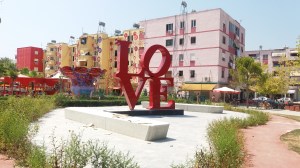
Cycle lanes. I remember while I was preparing for my DPSI exam a couple of years ago discussing the best way to say ‘cycle lane’, as it was something I had never come across in Albania. Now the centre of Lushnje has a cycle lane running right through it and, what is more, people were using it! In fact the whole of the central square has been made a no-car zone, and it’s lovely. (You can spot the red cycle lane in the photo above.)

Toffee apples. I associate these with frosty nights, Hallowe’en and bonfires, rather than with sultry Mediterranean evenings, but I don’t suppose there’s any good reason why Albania shouldn’t enjoy them just as much as we do. (I use ‘we’ in a generic sense – I hate fruit.)

Fried pizza. I thought this was purely a Scottish institution (served with chips, of course, because a deep-fried pizza doesn’t contain enough grease), but I suppose I shouldn’t really be surprised that such a delicacy also exists in Albania; they are awfully fond of frying things, often in gallons of oil.

I always seem to learn something new when I go to Albania, and usually not just about the cuisine. The rigmarole over the water supply in our house in Lushnje (two pumps in two different, locked locations, a valve on the roof and a stopcock half-buried in the yard – not fun) gave me a greater appreciation of the running water system we have here. In fact, our street might get proper running water before next summer, which would be wonderful!

I also learned to hold my possessions a bit more lightly. That’s already wearing off, since I live in a society where ownership is very clearly demarcated and closely guarded, but I do appreciate the Albanian willingness to lend and share, and not to care too much when something is lost or broken.

I was also reminded of the value of boredom. There’s a lot of waiting around in Albania; it’s just part of life. In the summer there are also times when it’s too hot to do anything, too hot even to sleep, so you just lie around. After a while, a bit of boredom opens up areas of your mind that lie dormant when you’re constantly busy or entertained, and that’s a good thing, especially if you work in a creative field. As well as getting on with the novel I’m working on (The Gates of Janus), I polished off a wee short story while I was there as well, which might not have happened if I didn’t have a lot of time just staring into the distance and dreaming.

So there’s your annual report on Albania. I can’t promise not to bore you about my budgie in future, but if you’re lucky something might occur to me that is interesting to a slightly wider audience 😉

A new decoration in Lushnje's park

Rio’s Hug

10 Aug

This blog post is simply going to direct you to another blog post, on Premier Christianity‘s website. But no, I’m not being lazy, because I wrote that post too.

If you have seen the statue of Christ the Redeemer on your TV during the Olympics, and want to hear my musings about its significance, and how it connects to the Games, please do have a wee read:

Christ the Redeemer: Why Rio’s statue is the true God of the Olympics

2199847917_266917357b_b

Photo: Paul Mannix

The compassionate embrace includes everyone, from Olympic athletes to drug dealers, from top politicians to favela kids.

Good Friday Thoughts

25 Mar

Good Friday is an odd one. It’s very solemn and sombre for Christians because we’re essentially pretending (by way of memorial) that Jesus is dead, even though we know that he has been risen for some time now. It’s an opportunity for ecumenical events (meaning joint with different kinds of churches), during which people tiptoe awkwardly around the fact that they know very little of their companions’ practice of faith or the vocabulary that accompanies it (communion/Eucharist/mass/Lord’s Supper; priest and clergy vs minister and leadership team etc.), even though it’s the same faith they’re practising. At post-service snacks, some enthusiastically scoff hot cross buns while others, who are fasting, quietly don’t. A strange time, but a bit of disorientation can be good to snap you out of your usual life and help you remember what this Easter lark is all about, anyway (and it’s not chocolate bunnies or the Babylonian goddess Ishtar, as a historically and etymologically illiterate Facebook meme would have us believe).

It’s an even stranger one than usual this year, because Good Friday (the memorial of the crucifixion) lands on the same day as the memorial of the Annunciation (when the angel announced to Mary that she would give birth to Jesus), meaning that (if you’re in a church that takes note of these things) we’re celebrating Jesus’ arrival as a baby whilst also mourning his death. I had only recently found out about the tradition that the Annunciation and the crucifixion were both on 25th March (to keep things nice and neat), so it’s quite serendipitous for me that in the year I find this out, the memorial of the crucifixion (which depends on the lunar calendar, thus a literally moveable feast) falls on the anniversary.

(There’s also a superstition that their coincidence is supposed to presage national disaster, such as the death of a monarch. Given how many famous people have already died in 2016, that wouldn’t be terribly surprising – but let’s hope it’s only as true as superstition usually is.)

Anyway, the article that drew my attention to this nice syncronicity is very well written and interesting, with lots of lovely pictures and (if you keep going to the end) a brilliant poem by John Donne called, rather unimaginatively, Upon the Annunciation and the Passion Falling upon One Day – so I will simply link to it so that you can enjoy it:

This doubtful day of feast or fast – Clerk of Oxford

Happy Easter!

The Stay-at-Home Missionary

28 Feb

It’s not often that I am moved to blog about a sermon I hear at church (though it does occasionally happen). Today we had a visiting speaker, Aaron Elder (who, despite his name, was almost unbearably young), and some of the things he said particularly struck me. That makes it sound as if our regular pastor’s sermons are not striking, which is unfair. They are often excellent, usually challenging, and if they suffer from using the phrase “what would it look like” more often than is warranted by normal use of the English language, well, so do Aaron’s. But maybe I was just ready to hear what Aaron had to say today – or, more accurately, what God had to say through him, because in any really good sermon the mouthpiece fades into the background.

Anyway, Aaron’s sermon was mainly about missionaries, and how we are all supposed to be missionaries. He dropped in some quotes by big hitters (he was almost apologetic by the time he invoked Kierkegaard; I was ready to cheer) and one of them was from Charles Spurgeon:

Every Christian is either a missionary or an imposter.

Of course this is hardly a new concept. I’ve heard any number of times the idea that we can’t all go abroad to be missionaries, but we can and should all spread God’s message of love where we are. I probably have a slightly different angle on this from most people, having been a missionary abroad; when asked what our mental picture of a missionary is (as a precursor to telling us we’re all missionaries), I think about my former friends and colleagues – although I have to admit that this image fights for space with the stereotypical image of a middle-aged woman in sensible clothes and besandaled socks.)

Anyway, when we were all being encouraged to think of where our ‘mission field’ is, I was, not for the first time, thinking “I don’t have any colleagues. I don’t have many friends, and many of the ones I do have are overseas.  I see my neighbours rarely. I don’t have a mission field.” Most people have to deal with a lot of people every day, whether they want to or not, but my work is just me and a computer, and that’s the way I like it. Even when I’m interpreting Albanian, I’m only supposed to be a human version of Google Translate (albeit a more accurate one); I’m not allowed to interject my own thoughts, any more than a Babel fish does.

However, while I indulged in this none-too-positive thinking, God* suddenly drew my attention to the fact that in a few weeks I’ll be speaking to over 200 people about St Patrick. In the week of St Patrick’s Day I’m visiting a school, talking to the whole of S1. Then I’m giving a talk on “Who was the real St Patrick?” at Govanhill Neighbourhood Centre the same week, on Friday 18th March. Neither of these talks are going to be evangelistic – I’m not luring people in and then preaching hellfire and damnation. But I will be speaking about another missionary, good old Pat, and mentioning why he went off to serve the Irish – which was of course because of his belief in God, and that God had sent him.** So while I may not have colleagues, or even many friends (don’t shed any tears, I do have some, and they are lovely!), I have a remarkably privileged opportunity that most people don’t get. Of course, I’ve also got my books, read even by people I’ve never met (so I’m told), so there’s a lovely, arm’s-length mission field – a Christian introvert‘s dream 😉

Where am I going with this? Nowhere really, except to observe that sometimes things can become new and fresh even when we’ve heard them a hundred time, and that perhaps even I have a mission field, even if it is limited in time, or extended in virtual distance.

__________________________________

*How do I know / why do I think it was God? It’s hard to be 100% sure when it comes to divine communications, but they do happen (if you’re a Christian), and they come in a number of different forms, from the unsettlingly supernatural to the surprisingly mundane. In this case, while mundane, the subject came to my mind unbidden, and in a completely different light from how I had seen it before, while I was in a prayerful, open attitude. That doesn’t prove anything, but I just thought I would explain since “God spoke to me” can be a rather confusing and ambiguous statement for the uninitiated.

** In his case it was a vivid dream in which he received a letter from the Irish – a little closer to the supernatural end of the scale.

Forgiving the unforgiveable

17 Nov

My new book on Patrick of Ireland is subtitled The Boy Who Forgave because what struck me most when I was researching his story was that Patrick was prepared to go back to the country where he had been trafficked and enslaved, not reluctantly or under compulsion, but with a heart full of compassion for the Irish.

The atrocities in Beirut and especially Paris have been all over the news and social media since Friday, and although the situation is not the same (the Irish raiders who carried Patrick off were no ISIS), I can’t help wondering how people would react if someone who had lost loved ones in the terrorist attacks then devoted most of their adult life to serving and spreading the word of God in the land the attackers came from. I expect that there would be some ready to question their motives, or their sanity. Our society tends to see forgiveness as weakness, but on the contrary, I think it takes immense strength, especially when it flies in the face of public opinion.

Patrick front cover

Anyway, all of that is just a prelude to saying that Patrick of Ireland: The Boy Who Forgave is now available in bookshops and online in Britain (you’ll have to wait a little longer in the USA) and tells a moving and thought-provoking story about a truly inspiring man whose life was anything but straightforward. Kidnap, shipwreck, near-starvation and attempted poisoning were just some of the things poor old Pat had to put up with, but his trust in God was unshakeable.

This is the stripped-back story of Patrick, relying on the most secure evidence and missing out the legendary bits that got added on much later. No snakes, shamrocks or breastplates, I’m afraid, but plenty of kings with unpronounceable names, druids, and high adventure.

Book launch

If you will be in Glasgow on Saturday 5th December, you are warmly invited to the book launch for Patrick of Ireland at 2pm in the private room of O’Neills Irish pub, Sauchiehall Street (right at the end of the street, almost at the motorway). If not, please do buy it from your local bookshop, buy online, or suggest to your local library that they get it in.

The Great British Turn Off

31 Aug

I understand that the 2015 series of the ever-popular Great British Bake Off is now underway. Or will be shortly. Or was recently. I’m not exactly sure of the details because I have never been the least bit tempted to watch it. That’s not because I don’t like baking. In fact, I love baking and am well known amongst my circle of acquaintances for my excellent cakes and biscuits. I do so much baking that my little niece thinks “recipe” means “a book that tells you all the things what you need in a cake”. So why do I dislike the Bake Off?

Until recently, I explained that to myself and others by saying that it was the competitive element that put me off. Baking isn’t supposed to be a competitive sport, it’s an enjoyable pastime. When lots of people bring baked goods along to an event, the fun is in trying and enjoying all of them, not in declaring one the winner and rejecting the others. But that doesn’t really explain it. I mean, I don’t object to the kind of baking competitions where you make the goodies at home and then take them along to be judged. I’ve even entered competitions like that in the past before, and written a heart-warming, tear-jerking and fairly well-remunerated short story for a woman’s magazine on the subject.

I could say it’s the stupidity of baking in a tent. (You need a constant supply of water and electricity, and no wind blowing your icing sugar around so let’s hold it – in a tent! Ideal!) Or I could object to the hosts or judges. But actually my problem with it clicked when I read an article on introversion and it mentioned baking as an activity introverts can use to recharge. That’s it! Baking is a solitary, peaceful activity. If you make it into a big public thing, with everyone shouting and making noise and peering over your shoulder, it becomes a trial to endure, not a source of relaxation. My objection to The Great British Bake Off, it seems, is that I’m an introvert.

(As an aside, it’s also a slight quibble I have with the Macmillan World’s Biggest Coffee Morning. It’s an excellent cause, but I have to disagree with their statement that “cake tastes better together”. Cake most definitely tastes better alone.)

It’s normal for writers to be introverts – lots of deep thoughts, internal monologue and spending time alone with computers, paper, pens and books. (I love stationery – not sure if that’s connected.) But it’s not always easy to tell who’s an introvert and who isn’t, unless you know them well. I can be quite the social butterfly, in fact, meeting new people, remembering their names and making amusing small talk, but I couldn’t do it all day. In fact, if I spend all day with large groups of people, even people I like, I will be ready to burst into tears about nothing at all by the evening. I need time by myself to chill and recover, doing things like reading, watching TV, and baking.

The article that mentioned baking has a great explanation of introversion described in terms of mobile phone batteries. The basic gist is that it’s not that introverts can’t do outgoing, social things, it’s just that it drains the batteries, which then need to be recharged. It’s a good article and I would recommend it. I would also recommend that you try my baking if you ever get the chance, and read my writing (naturally). But don’t stand over my shoulder while I’m doing it, giving me marks out of ten. This is not the Great British Bake Off.

Introverts Unite

Albania 2015 – just the best bits

8 Aug

I have recently returned from my other reality, aka Albania, where I have a different name, a different language, different clothes (well it is 20 degrees hotter) and to some extent a different personality. I was going to blog about how strange it is to suddenly be bad at things that you are usually good at – things like baking, dancing and writing, in my case – because you’re in a different culture where all the rules are changed.

However, I feel like I have encountered quite enough negativity recently, with people talking down Albania, or Scotland, or just generally moaning about how hard life is, so I don’t want to add to it. However hard life is, and whatever problems there are in both my countries, I had a fantastic month, so I will choose the share the best parts. If that makes you nauseous, look away now.

1. I went to a museum in Lushnjë where I was the only person there, so I got a personal guided tour, and unlike most museums where you are told very firmly not to touch, this museum positively encourages you to! I was handed a two-and-a-half-thousand-year-old perfume pot (which I took extreme care not to drop) as if it were just a mug of coffee, and the tour guide passed me an 18th century sword to hold while he took a phone call. For a history nut like me, it was amazing!

IMG_20150712_110556768

Look at the colour of that sea!

2. The sea was beautiful, and so different from the North Sea and the Atlantic that I grew up with. It’s so clear you can see the tiny fish, and it’s warm (or no colder than cool, at worst) so you can get right in there without fear of losing a toe to frostbite. My eyes are the colour of the sea and, bizarrely, while they are North Sea blue-grey here in Scotland, they were Mediterranean blue-green the entire time I was in Albania.

3. Being outdoors so much was great. I like being outdoors in Scotland, too, but there are not that many days you can do it without suffering from mild exposure, if not from the temperature then from the wind. In Albania (and Greece) we ate outside (breakfast, lunch and supper), socialised outside, went to outdoor bars, and I even slept outside, on the balcony outside my room, when the temperature got a bit too ridiculous. Waking up to blue sky and swallows overhead sets you up for a great day.

IMG_20150726_230541762

My bed on the balcony

4. My husband gets irritated by this one, but I love being mistaken for an Albanian! I talk with an accent of course, but millions of Albanians live abroad, so they pick up accents too. Sometimes people have a little debate in front of me about whether I’m foreign or not! It’s very funny, and quite reassuring when I have an Albanian exam coming up later this year.

5. I enjoyed bonding with my mother-in-law over telenovele, the überdramatic soap operas they show in Albania. They used to be mainly from South America, but now there’s a glut of Turkish ones, which are a bit more serious, and very good. The latest was Diamantë dhe Dashuri (Diamonds and Love). There’s lots of mortal peril and complicated love triangles / hexagons, and I am happy to throw myself right in there for as long as I’m staying. They also don’t go on forever, like British soap operas, so you’re not in danger of losing your whole life to them.

6. I also enjoyed dressing up. This can be a hassle if you’re not in the right mood, but I was on holiday so I was very happy to only take my prettiest clothes, and then to wear all the new pretty clothes that my mother-in-law had collected for me too. Most of the time in Britain I slob around in jeans and a t-shirt, so it’s fun to take a break from that and wear heels and dresses. I didn’t wear trousers for the entire holiday, and it was with great reluctance that I put them back on for the flight home.

7. The ice cream was so cheap! Lots of things are cheaper in Albania, but ice cream is so expensive here in Britain that it’s really noticeable. In Albania it ranged from about 30p for a cheap one to £1.30 for an individual tub of Skandal, the equivalent of Häagen Dazs. My young nieces, who accompanied me for the first part of the holiday, weren’t used to the heat so I insisted that we stabilised their temperature with regular applications of ice cream. They didn’t seem to mind.

8. Catching up with friends was a highlight – and not just friends in Albania, but those in Greece and Italy too! Because almost everyone in Albania has relatives abroad, standard mobile phone packages include overseas minutes. For about £8 for the whole month I got hundreds of minutes to Europe, as well as huge amounts of data and messages. Not bad.

9. This one is from Greece rather than Albania. I stayed in a hotel with a pool on my way back, since I had to spend a night in Corfu. (It was the Anita, in case you’re interested, and it’s very good and extremely friendly, though not as handy for the airport as the Arion.) One of my favourite memories is standing up to my neck in the pool, alone, watching brightly coloured dragonflies playing over the water. Idyllic.

Sunny enough for bananas!

Sunny enough for bananas!

10. Sunshine. Sorry, but it has to be said. In Scotland we throw ourselves onto the nearest patch of grass whenever the sun comes out, because who knows how long it will last? In Albania you can predict that it will last roughly from the start of May to the end of September. It was sunny every day, it was hot every day, it was cloudless all but two days. It was paradise.

My mother-in-law will hopefully be visiting in October, her first time in Scotland, so it will be interesting to get her perspective. Maybe she will see wonderful things that I don’t notice because I’m so used to them. I have a nasty feeling that she won’t like it at all, actually, but until she casts her verdict – let’s stay positive. 🙂