Archive | Reviews RSS feed for this section

All’s Well That’s As You Like It

13 Aug

My good friend Rebekah Holden (who is the same person as the actress Rebekah Harvey, since actors are supposed to have unique names) had kindly posted guest post by me on her lovely blog. It is a simple, 5-step guide to writing a brilliant Shakespeare comedy. Just add genius. And comedy.

All’s Well That’s As You Like It; How to write a Shakespeare comedy

An Unexpected Guest

1 Aug

One of the things I love about the internet are the random connections it throws up. I clicked through from Twitter to a list about books that are better than the films (as a writer and a film fan that’s the kind of clickbait I’m very vulnerable to.) Of course, one of the things that is very irritating about the internet is the difficulty in finding anything again, unless you’ve bookmarked it, so I can’t give you the link to the list, I’m afraid.

Anyway, there were two books on the list that I hadn’t read. One was Fight Club by Chuck Palahniuk, which I have ordered from the library, and the other one was I am Legend by Richard Matheson. And just like that, I have added a name to my list of favourite authors, because it turns out that this man, whom I thought I’d never heard of, not only wrote the story Somewhere in Time (or Bid Time Return), which I really enjoyed but had completely forgot the title and author of, but he also wrote the screenplay of one of my favourite films, The Incredible Shrinking Man! (Yes, it sounds awful, but it’s actually a very thoughtful and touching film. And the fight with the giant spider is great!)

Continuing the theme of random connections, in the book I am Legend the narrator makes a joke about the last man on Earth being Edgar Guest. Not having the first clue who Edgar Guest was (although I could tell from the context he was probably a wordsmith of some kind), I naturally reached for my smartphone and looked him up. He was a poet, as it turned out, and the first poem of his that I turned up (courtesy of the Poetry Foundation), I rather liked. It’s also a very good fit for the book, in which a man keeps going in almost overwhelming circumstances. So here it is for you to enjoy, and I hope that my blog will also be a source of serendipitous connections in the vast internet.

It Couldn’t Be Done

BY EDGAR ALBERT GUEST

Somebody said that it couldn’t be done
But he with a chuckle replied
That “maybe it couldn’t,” but he would be one
Who wouldn’t say so till he’d tried.
So he buckled right in with the trace of a grin
On his face. If he worried he hid it.
He started to sing as he tackled the thing
That couldn’t be done, and he did it!

Somebody scoffed: “Oh, you’ll never do that;
At least no one ever has done it;”
But he took off his coat and he took off his hat
And the first thing we knew he’d begun it.
With a lift of his chin and a bit of a grin,
Without any doubting or quiddit,
He started to sing as he tackled the thing
That couldn’t be done, and he did it.

There are thousands to tell you it cannot be done,
There are thousands to prophesy failure,
There are thousands to point out to you one by one,
The dangers that wait to assail you.
But just buckle in with a bit of a grin,
Just take off your coat and go to it;
Just start in to sing as you tackle the thing
That “cannot be done,” and you’ll do it.

Review of Augustine: The Truth Seeker

12 Jun

Danika Cooley, of the website Thinking  Kids, has kindly written a review of Augustine: The Truth Seeker, giving advice about how it would fit into a homeschooling curriculum. Specifically she identifies these subjects as ones where Augustine would fit in well:

  • Ancient History
  • The Early Church
  • Manichean Beliefs
  • The Donatists
  • The Roman Empire
  • The Fall of the Roman Empire

I don’t actually know Danika, so you can get an unbiased view of Augustine by reading her review. Or better still, form your own unbiased view by reading it yourself! It’s available from Christian bookshops and online (Amazon, Eden, TenofThose, Christian Focus website etc.).

From Here to Remember Me

31 May

I saw the film Remember Me recently. You may have done, too. For some reason now TV is multi-channel and digital, schedulers feel the need to show a film about twenty times over a month. It’s a sweet enough little film, boy meeting girl and family members being reconciled and so on. I got quite into it and watched right to the end – which is where the problem lay.

*SPOILER ALERT* Please don’t read any further if you don’t want to know the ending of Remember Me.

Remember_me_film_poster

The thing is, for no apparent reason, when things are all going swimmingly, the main character, Tyler, dies in the 9/11 attacks. I was a bit nonplussed, and had a wee look on IMDB where I found that the director, Allen Coulter, had intended the film to end with the attacks all along – he hadn’t just run out of ideas and killed the character off, which is what it felt like.

There had been no indication of the date when the film was set, although it was clearly recent or contemporary. Tyler’s father works in an office in New York, but although the inside of the office was shown a few times, it was not until the planes were coming in that it was revealed that his office was in one of the twin towers of the World Trade Center. Perhaps that should have made the ending more poignant and shocking, but it didn’t. In fact it made it slightly ridiculous, like a Monty Python sketch where they got bored and just decided to bring in an explosion or wrecking ball or other distraction.

Interesting, at around the same time, I also had the chance to see From Here to Eternity all the way through. It’s one of those films where everyone has seen one scene (the one in the picture below), but no one seems to have seen the whole thing. I only saw it because I was recovering from a nasty stomach bug and had crawled from my bed of sickness onto the sofa to watch some TV.

The reason I mention the two films together is that From Here to Eternity also has a cataclysmic event at the end, but it’s handled much better.

*SPOILER ALERT* – as before, if you don’t want to know what happens, don’t read on.

From_Here_to_Eternity

In the case of From Here to Eternity it’s the Japanese attack on Pearl Harbour. As with Remember Me, the world-shaking event is not the focus of the film, which is about the rather seedy romances of some soldiers stationed on Hawaii. That’s the first clue, though: soldiers stationed on Hawaii during the Second World War gives an indication that Pearl Harbour is coming, if you care to think about it – but the film is engaging enough that you don’t stop to think about it.

There are other clues, too – the fact that America will probably soon enter the war is brought up a couple of times, and there’s the classic doomed love omen. You know it’s never going to work out, so something is going to go wrong, although you don’t know what. When the attack comes, it’s shocking, but at the same time it feels right, it ties in with the situation as it had been painted. You don’t feel cheated or confused, just a bit foolish for not realising it sooner (or perhaps that’s just me – maybe everyone else gets it a lot sooner).

It reminded me a bit of Cecil Hunt’s advice on solving problems in stories (which I’m sure is in his book Short Stories: How to Write Them, although the specific paragraph is hiding from me at the moment. That book, by the way, is the best and most practical book I have ever read on writing, and I would heartily recommend it.) He says that it’s fine to have the heroine beat the villain through her knowledge of kung fu, for example, but only if you’ve actually mentioned at some point that she knew kung fu, or was taking classes or something. Otherwise you’re left with the much-ridiculed “with a single bound, Jones was free” solution.

Of course, that rule doesn’t always apply. No warning whatsoever can work well for small shocks, as it does in the Final Destination films (a guilty pleasure of mine). Equally, it can be used for humour. In the extremely cool film Swingers, there’s a part where the shy, nervous, awkward hero plucks up the courage to ask the girl to dance with him to a nice safe slow number, and then a jive song comes on. She persuades him to stay on the floor, so he jives away in an understated, shy sort of way, then puts in a few wee turns, then some lifts, and then he’s suddenly the king of the floor, throwing amazing moves and impressing the girl. Afterwards his friends, who are as amazed as the audience, ask him how he could do that and he reveals that he took classes. It’s the “with a single bound” thing, but because it’s meant to be laughable, it works.

The problem with Remember Me is that it’s not meant to be laughable, it’s meant to be extremely sombre and thought-provoking. However, instead of making people think about the effect of 9/11 on ordinary lives, it just makes them think “what, how, huh?” If there had been the odd hint thrown in about the impending tragedy, the audience would have been emotionally ready to accept it, as in From Here to Eternity, but instead they emotionally reject it. Does not compute. Insufficient data.

Keeping the audience in the dark might work for small shocks, but when it comes to big shocks that the story rests upon, it seems that too much surprise undermines the shock rather than increasing it. It reduces it to a clever trick, draining it of all pathos. That, at least, is why I think the ending of Remember Me doesn’t work. You may disagree. Feel free to leave a comment with your thoughts, but be aware that this webpage may explode without warning while you are wri

Singer Song of a Fiver

22 Mar

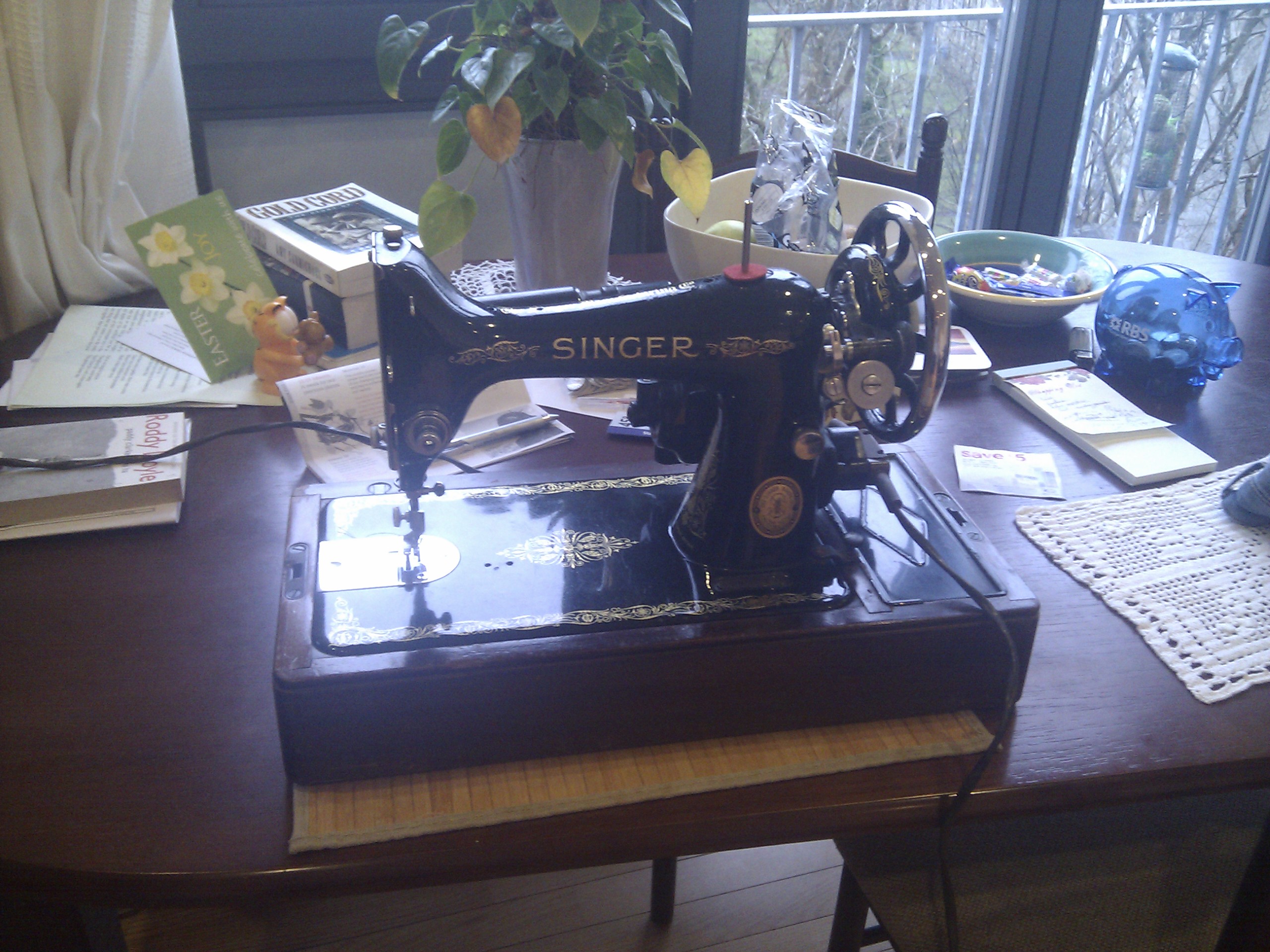
I feel another rant coming on soon (dogs, in case you’re wondering), so to avoid having two rants in a row and making you think I’m some sort of Mrs Angry, I’d like to stick in a wee paean of praise to my Singer sewing machine. I bought this little beauty for £5 at a jumble sale, hence the post’s title. I got it for a fiver because when the bloke selling it told me the price, which was £10, I replied,”Ten pounds?” incredulously, thinking “That’s so cheap!” He mistook my incredulity and said, “Ok, five pounds then.” I didn’t argue – I just called my husband to carry it home for me. (That’s what they’re for. That and killing spiders.)

The model I have dates from about the 1950s and is one of the earliest electric kinds, which is handy because I have never got the hang of a mechanical foot pedal. It is probably made of cast iron (although it feels like it’s made of lead), requires regular oiling,IMG_20130316_162536 and is painted pretty colours in that old Singer way. It came with an integral compartment full of useful bits and bobs, including an instruction booklet that smells very old. (I love the smell of old books. Especially 1960s paperbacks for some reason.)

The Singer earned back its £5 layout the first time I shortened a pair of jeans. Since then, it’s been in profit. It’s also become more ambitious, moving on from just shortening legs to taking in waists, converting jeans to a skirt, and even producing an authentic(ish) Regency Period dress for a Jane Austen ball out of some sheets and pillowcases.

I’m not actually much of a sewer (no, really – crochet is my bag), certainly not a dressmaker, but despite that I have had reason to be glad of my purchase many times. And its sturdy carrying case even makes a handy additional coffee table. Probably the best five pounds I’ve ever spent.

Toilets I Have Known (on a scale of one to ten)

9 Mar
The Trainspotting Toilet - about a three.

The Trainspotting toilet – about a three.

I have a rather idiosyncratic approach to toilets – so much so that a friend suggested I share it on my blog. I’m not referring to the way I use toilets, which is entirely normal. (Athough really, in the privacy of the cubicle, who knows what is normal?) No, I’m referring to the fact that I award them a score on a ten point scale.

This is just public toilets, I should probably say. I’m not going into people’s houses, wrinkling my nose and saying, “No better than a six,” like some contestant on a lavatorial version of Come Dine with Me. However, when using a toilet in a public place for the first time you might well find me doing that.

This started as a coping mechanism in Albania. In the less developed parts of the world you are far more likely to find toilets that I would consider to be on the lower end of the scale, and using them can be quite a trying experience. To help, I would assign them scores, which is not only a distraction in itself, but also reminds you that it could be worse.

So what are the criteria for scoring well on the WC scale? It’s partly subjective, but here are some of the basic elements that score a toilet points: a door that shuts; a lock on the door; a light source; the ability to flush; toilet paper, and somewhere to dispose of it; water to wash your hands, preferably running; soap; a method of drying your hands; a hook (see my post on disabled toilets); a mirror; an inoffensive smell. Extra marks can be gained for having such luxuries as hand cream, aesthetically pleasing decor and floor-to-ceiling cubicle doors.

Some of these seem pretty essential, do I hear you say? You’d never find a toilet without them? Oh yes you would, and I have seen facilities missing all of these things, though usually not all in the same toilet.

So let’s examine both ends of the scale. Although in Britain you wouldn’t expect to find less than a 6 at worst, it takes something special to reach the perfect 10. Toilets in art galleries and beauty salons often score 9s or 10s, as do posh restaurants and hotels, but possibly the nicest I have ever seen is in The Blythswood Hotel in Glasgow. I may not like their attitude to ordinary working folk, but I can’t fault their toilets: a haven of peaceful salubriousness, with restful lighting, lovely fittings, and tiny single use hand towels that you throw in a basket afterwards. Bliss – definitely a ten.

What about the other end of the scale? What kind of a toilet scores just one? Are you thinking of the filthy loo in Trainspotting? No, that’s about a 3. Disgusting as it was, it had a door (that locked, I think) and sinks to wash your hands. The toilet in Slumdog Millionaire, then? Again, no. It had a door and someone to guard it. I think there may even have been paper. It would score at least 2. So is it possible to score only 1? Yes. I have seen the worst toilet in the world (I believe). It was in Albania, I think in Erseke though it may have been Leskovik. It was a hole in a concrete floor above a river. The room had three concrete walls; the fourth side was entirely open to the road, from where I observed it. I did not use it. That’s how you get a 1. So the next time the loo roll has run out or the hook is broken, think of Erseke, and be grateful.

Shadow’s Dawn by H K Miller

8 Dec

Shadows Dawn coverI must plug this book that my cousin has just released on Amazon, not just because he is my cousin but because it is good.

I can’t tell you about the plot arc properly because I haven’t read it right to the end (something I will put right very quickly) but I’ve read large sections of it to help edit it and I can tell you that the boy can write. I’ve suffered through too many badly written books to take that lightly.

It’s a fantasy novel set in a time when humans live in primitive hunter-gatherer tribes while the elves are far more civilised, but a threat is going to force them to work together. The characters are more real and earthy than in many fantasy novels – they’re irritable, they get drunk, they worry about the future not just of the world but of their tribe’s food sources. It’s got a bit of bite and realism that makes the story matter, avoiding the “so what?” reaction that can greet world-shattering crises in fantasy novels.

If you like fantasy, and you have a couple of quid to spare (I know it’s a recession, but you can stretch to £1.93), download Shadow’s Dawn, and let me know what you think.

Amazing Adverts

22 Nov

As a balance to the last post about annoying adverts, here is a list of the top five adverts of all time.*

5) Google Superbowl Advert (2010)

I had to be persuaded to put this one on the list, since it’s by an evil multinational conglomerate, and it’s probably never even been shown in Britain (I stand open to correction), but when I agreed to watch this it did make my eyes go a little moist. It’s sweet, and true, if you know what I mean. It deserves a place.

If I hadn’t put the Google ad in, it would have been the John Lewis ad in which a baby girl grows up until she’s a grandmother. It’s lovely, if only because of the Billy Joel song backing it.

4) Irn Bru Snowman (2006)

This is quite a recent advert, but very funny. The visuals are just like the film “The Snowman”, and so is the angelic choirboy’s voice. The lyrics aren’t. “Now I’m falling through the air, I wonder where I’m going to land. He nicked my Irn Bru and let go of my hand.” It’s The Snowman if it had been set in Glasgow.

(A note of interest for those readers not from round here – this advert shows cartoon versions of many famous Scottish landmarks, including ones from Glasgow, and the boy actually lands in George Square in the centre of Glasgow.)

3) Boddingtons – The Cream of Manchester (1992)

Dusk. Plush surroundings. A beautiful woman in a black cocktail dress applies white cream to her face while a voiceover tells you how luxurious it is. Then we see it’s beer foam. A suave man in a suit comes in, embraces her and bursts out, “By eck! You smell gorgeous tonight, petal!” in a broad Northern accent. I think it works because there were plenty of Milk Tray and perfume adverts that looked much the same, so you really didn’t see it coming.

2) Batchelors Mushy Peas (1994)

This is how Batchelors make peas mushy: They get Craig Charles to talk to them about the good old days, back on the farm. Cruel, but funny. (A word of warning about the link – there is other stuff before the Batchelors ad. The advert itself starts 28 seconds in.)

1) Clarks Magic Steps Shoes

This is a magical blast from the past. I think this advert is from the 80’s. It absolutely hooked the target audience – wee girls, of which I was one at the time. It was probably about the same time as the film “Labyrinth” was around, and it goes for the same normal-girl-in-magical-world conceit. To really understand the appeal of this ad, though, you have to watch it and then consider this fact: the shoes actually had a key in the sole! This advert has stayed with me for many, many years, and deserves first place in my little list.

* These adverts have not been selected in a scientific way and may not actually represent the best five television advertisments of all time. Please do not complain to the Trading Standards Authority about this post. Instead, complain about those Channel 4 “Top 100” programmes where the best item is always at number 2, while number 1 is some piece of drivel.

Understanding Karenina

11 Sep

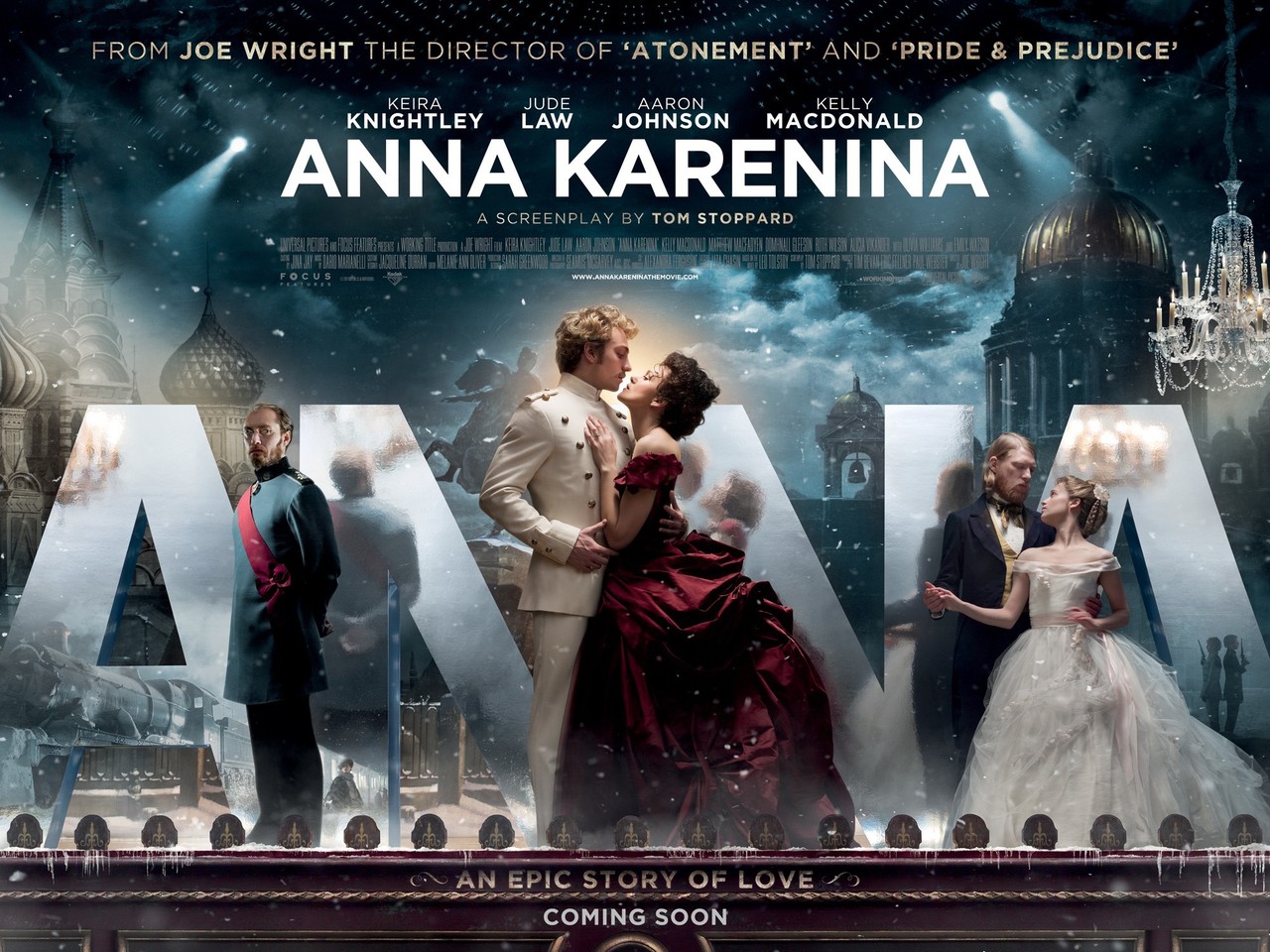
Last night I went to see the new film of Anna Karenina, adapted by Tom Stoppard. I had read the novel, but it was a good few years ago and going into the film I was carrying around the thought that Kitty was “young” and Anna was “old” – not old old, of course, not in need of a walking frame, but middle-aged. After seeing the film, and through it remembering the book, I realise that I was wrong. Anna is not old, even though Kitty is a good decade younger. She has been married for many years, yes, but she was only 18 when she got married. What Anna is, is an Older Young Person.

I use that phrase as if it’s an official description because, at my church, I sometimes put on events for Older Young People. It’s a category that’s not well-defined, but which I fall into myself. At the lower end it includes people who really are very young, in their early twenties, but who are no longer students and have therefore outgrown the previous stage of their life and been replaced by new models rolling in for Freshers’ Week. At the top end are those who have proper jobs and houses and so on, and have had for some time, but still sometimes feel like they’re not ‘proper’ grown-ups; people who notice, with incomprehension, that there are folk ten or fifteen years younger than themselves who can drive, marry, drink alcohol, seek gainful employment (though finding it is rarer these days), and in most other ways appear to be functioning adults. We are still young, but no longer obscenely young. This is the Older Young Person.

Now that I am a few years older than I was when I read the novel, I understand Anna a lot better. She didn’t want to hurt Kitty, of course, and even felt protective of her, but the ability to turn Vronsky’s head when that part of her life was supposed to be behind her was intoxicating. It wasn’t just Vronsky’s good looks and charm that tempted her, it was being seen as an attractive woman in her own right, not someone’s wife or mother or aunt. The kind of person who might dance at a ball. The kind of person who might embark on a love affair. A young person.

I don’t have to cope with a stale marriage, nor have I ever found myself infatuated by another man since I met my husband (for which I thank God), but for all that I know a little of what Anna was going through. She was beautiful, may even have become more beautiful with age, but she had lost the dewy glow of youth that Kitty brandished so innocently, and no amount of BB cream can ever give you that back. She had made her choices, and they were good ones, but the thrill of having life choices to make is so much more exciting than the satisfaction of having made them. Kitty’s rival was another woman, but Anna’s rival was time itself, and that’s a much scarier adversary, because he always wins in the end.

I’m rather pleased (and not a little surprised) that the new film does leave in all the moral censure that gives the story of Anna Karenina its point; what Anna does is understandable, but like many understandable things it’s also very wrong. So while I may look in horror at the dates of birth of some of my younger friends (how can someone born in the 90s even tie their own shoelaces yet?), I won’t be embarking on a torrid affair with a young cavalry officer. Instead, I will invite my Older Young friends round for dinner and laughs. And refuse to tell anybody under 25 my age.

Scots, Scottish English and Scottishness

11 Aug

I really ought to be studying Latin just now (I’m trying to get my Latin A-level. It’s a long story.) but instead I find myself thinking about Scots. Scots is what we in Scotland call our language. It sometimes gets called “the Scottish dialect”, since it is a branch of English, but it’s actually (if you want to get technical) a national language variant rather than a dialect. Anyway, what it’s called is not really the point, the important thing is what it contains, in terms of language, and who uses it.

What set me off thinking in this vein was the Pollok Park Family Day last Saturday. There were lots of animals in a big muddy field (it was a lot better than that makes it sound), and commentating on the various animals and activities was a Scottish man. That’s hardly surprising, as Pollok Park is in Glasgow. (It is a very impressive country park, incidentally, and home to the Burrell Collection amongst other things.)

This Scottish man used lots of Scottish words – muckle, clatty, that sort of thing. The problem was that they didn’t sound natural. He sounded as if he had a list of “Authentic Scottish Words for Speakers at Scottish Events” and he was determined to squeeze in as many as he could. It left me feeling a bit ambivalent. I don’t want these words to die out, and they will if the younger generation doesn’t hear them, but then what’s the point in having them if they’re only party pieces, words that you have to go out of your way to use, and pat yourself on the back when you do?

A lot of people still do use Scots words, including those who don’t realise they do. People in the rougher parts of Glasgow could never be mistaken for speakers of the Queen’s English, but at the upper end of the Scots spectrum is something sometimes known as Scottish English, which is what they speak in the Holyrood (the Parliament) and what you find in business letters here. Most Scottish people would think it was just English with a Scottish accent, except that there’s the odd wee difference that you would only notice if you weren’t Scottish, such as the word “outwith”: Perfectly acceptable and rather formal within Scotland, but unfamiliar outwith it.

A better example of how Scots can work as a modern language is found, rather surprisingly, in the Disney film Brave. It’s set in some unspecified medieval period, but the people speak more or less modern Scots. Not the full-on, Rabbie Burns version, but it features plenty of vocabulary, and even grammar, that isn’t found in standard English. (I did enjoy the line “[A princess] disnae stuff her gob!”) It doesn’t all ring true, but the vast majority of it does, probably because the actors are actually Scottish. And there’s a wee gem in the film for Scottish language enthusiasts – a lad who speaks Doric (the dialect of the North East) and is completely unintelligible to the rest of the folks speaking ‘standard’ Scots.

Of course, the reason I take such an interest in the subject is that I don’t really speak Scots myself. I lived in England for many formative years, and although I can understand Scots (except Doric – no-one understands that), speaking it comes about as naturally to me as the pointedly Scottish words did to the MC at Pollok Park. I, therefore, will not be much use in preserving the language except as a semi-external observer. But then, as Rabbie said, isn’t one of the greatest gifts “tae see oursels as ithers see us”?