The Painted Castle published on Channillo

1 Sep

My humorous short story “The Painted Castle” has just been published on Channillo as part of its 2016 competition finalists series. (My entry was joint third so I am officially a ‘winner’ 🙂

Channillo is a reading site where you subscribe to various series of fiction and non-fiction. Unfortunately it’s a membership-only site (apart from a few bits and pieces) so my story is behind a paywall, but subscriptions start from $4.99 per month (cancel anytime) so you may consider it’s worth it.

I’m quite fond of this wee story, actually. It makes me smile, partly because of the humour in it, partly because it reminds me of lovely family weekend in the place that has been fictionalised as ‘Anderswick’. I hope it makes you smile, too.

Life’s a Beach

14 Aug

I’m not long back from my latest excursion to Albania. I didn’t spend as long as usual this time, just the three weeks (I know, your heart bleeds), but I did find some time to get away to the beach while I was there, and thought I would give a quick impression of the differences between British beaches and Albanian ones (or Mediterranean ones more generally). If you’ve spent time at both and know all this already, feel free to skip, but if you’ve never experienced the sweaty hedonism of a Mediterranean beach, or the chilly exhilaration of a British beach, read on.

Seagulls

This was the thing that got me thinking about the differences to start with. I was lying on my lounger (of which more later) in Spille, reading This Must Be the Place, when I heard what I thought was a seagull crying. In Scotland, this sound is so ubiquitous at the coast, and even in cities, that you don’t register it, but when I heard it on that beach I suddenly realised it was the first one I’d heard. So I looked up to see – a man selling squeezy horns for kids to play with, along with other toys and games.
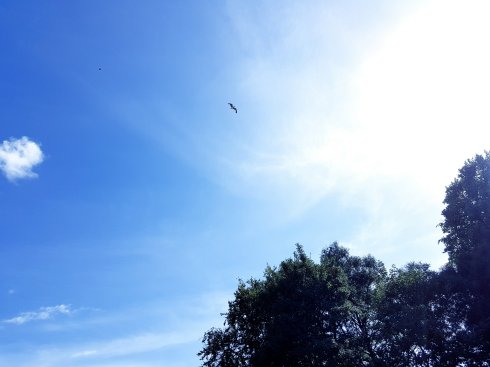
A seagull doing its thing

In Scotland, and the rest of the UK, seagulls hang above the seaside like stringless kites, ready to dive-bomb anyone who is too careless with their chips. At Spille, the avian background music was provided by peaceful wood pigeons, or duduftu (brilliant piece of onomatopoeia).*

Vendors

If you harbour dreams of being waited on hand and foot, or fondly imagine that you were Cleopatra in a former life, Albanian beaches might be for you. You can turn up with just your towel and your swimsuit, and people will come round selling you everything else you need, including on beaches where this is explicitly prohibited. Here are some of the items that will come to you, if you wait long enough:

  • Doughnuts
  • Playing cards
  • Novelty horns (see above)
  • Newspapers
  • Bananas
  • Cold(ish) drinks
  • Sets of dominoes
  • Candy floss
  • Inflatables
  • Buckets and spades
  • Corn on the cob

Some of the more touristy beaches even have massage and hair braiding. No one seems to sell novels though, so bring your beach read with you. In Britain for sale actually on the beach you will find:

  • Donkey rides

And that’s about it. That’s not to say you won’t find plenty to eat and drink and amuse yourself near the beach, but there’s pretty much nothing on it. There’s a reason for that, and it’s the same reason that lies behind point 3:

Sun loungers

Shezllone in this picture is not the name of a place, it is the Albanian word for sun lounger, which they have clearly borrowed from the French. (Say it out loud and see if you can work it out.)**

Albanian beaches, and Mediterranean beaches in general, are covered with pairs of sun loungers arranged in neat rows, usually with an umbrella complete with mini table. There are obvious advantages to this system: you don’t get nearly as sandy, the sand doesn’t blow over you, you’ve got shade without having to hoik an umbrella around with you, you’ve got somewhere to put your drink and hang your clothes, etc.
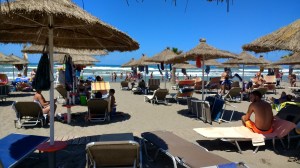
The disadvantage is that these loungers belong to someone, usually to the adjoining beachfront hotel or café, and you have to pay to use them. If you don’t want to, you’ll struggle to find an unused bit of beach to lay your towel on. Being a bit lazy, especially when it comes to carrying things in hot climates, I like the shezllone system, but I understand why it wouldn’t work in Britain. Even if we did have enough hot weather to justify permanent beach furniture, there’s a very good reason why nothing is left on the beach overnight, which is…

Tides

On our second day in Spille, it was very windy (though still hot) and this meant that the sea was full of waves. My mother-in-law thought that made it very unsuitable for swimming and was a bit concerned when I went in, but for me it brought back memories of holidays as a kid, jumping over small waves and body-surfing the big ones (and ending up with lots of salt water in my nose). This is because the coast in Britain is full of waves all the time, whether it’s windy or not, because we have tides.

It’s one of those things that feels unrealistic, like the water running down the plughole in the opposite direction in Australia (allegedly; I’ve never been). When you’ve grown up with a sea that advances and withdraws by hundreds of yards twice a day, it just doesn’t feel safe to leave your sandals right next to the water, even though you know they’ll be just where you left them when you come out. I have a vivid memory of seeing my clothing float past me at Southport, even though we had all left our clothes way up the beach. It’s hard to get used to the calm, stationary Mediterranean, with its more-or-less stationary waterline.

It’s easy to get used to warmth, though. Sometimes even the Mediterranean seems too cold to me these days, and I grew up paddling in the Atlantic, and even went swimming in the North Sea at five in the morning. I have become nesh.

Kids

My final observation is really a reflection of wider Albanian culture, not just beach culture. Kids go everywhere, at every time of day. There were kids on the beach in the blazing heat of noonday. If they got crotchety (as you would expect) the solution was to put them down for a nap, tucked under a sheet – on a sun lounger in the blazing heat of noonday. This would not be recommended practice in Britain, to say the least.
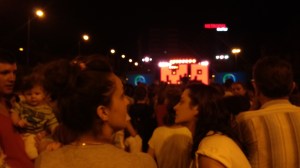
But kids go everywhere and sleep anywhere in Albania – including music concerts. In the photo above you may be able to see small children and babes in arms at the Maratona e Këngës (Song Marathon), which started at nine in the evening. “Are all the bairnies in their beds? It’s past eight o’ clock” does not ring true in Albania. In theory they should all be suffering terrible developmental problems due to the haphazard sleeping patterns, irregular meals, excessive exposure to TV etc. But in reality they seem to turn out fine, so maybe they’re doing something right.

Anyway, now it’s back to late summer in Scotland for me, which in practice means cold and rain. It’s been excessively hot on the Continent and, as is often the case when that happens, it’s been unusually cold and miserable here. So no one will see my beautiful tan because I’m wrapped up from head to toe all the time. But if you bump into me, do feel free to compliment me on my wonderfully bronzed hands 😉


*  Please don’t give me any of that rubbish about seagulls not being a real thing. They’re gulls. They live by the sea. They’re seagulls, alright?

** Chaises longues

In Darkest England 

7 Aug

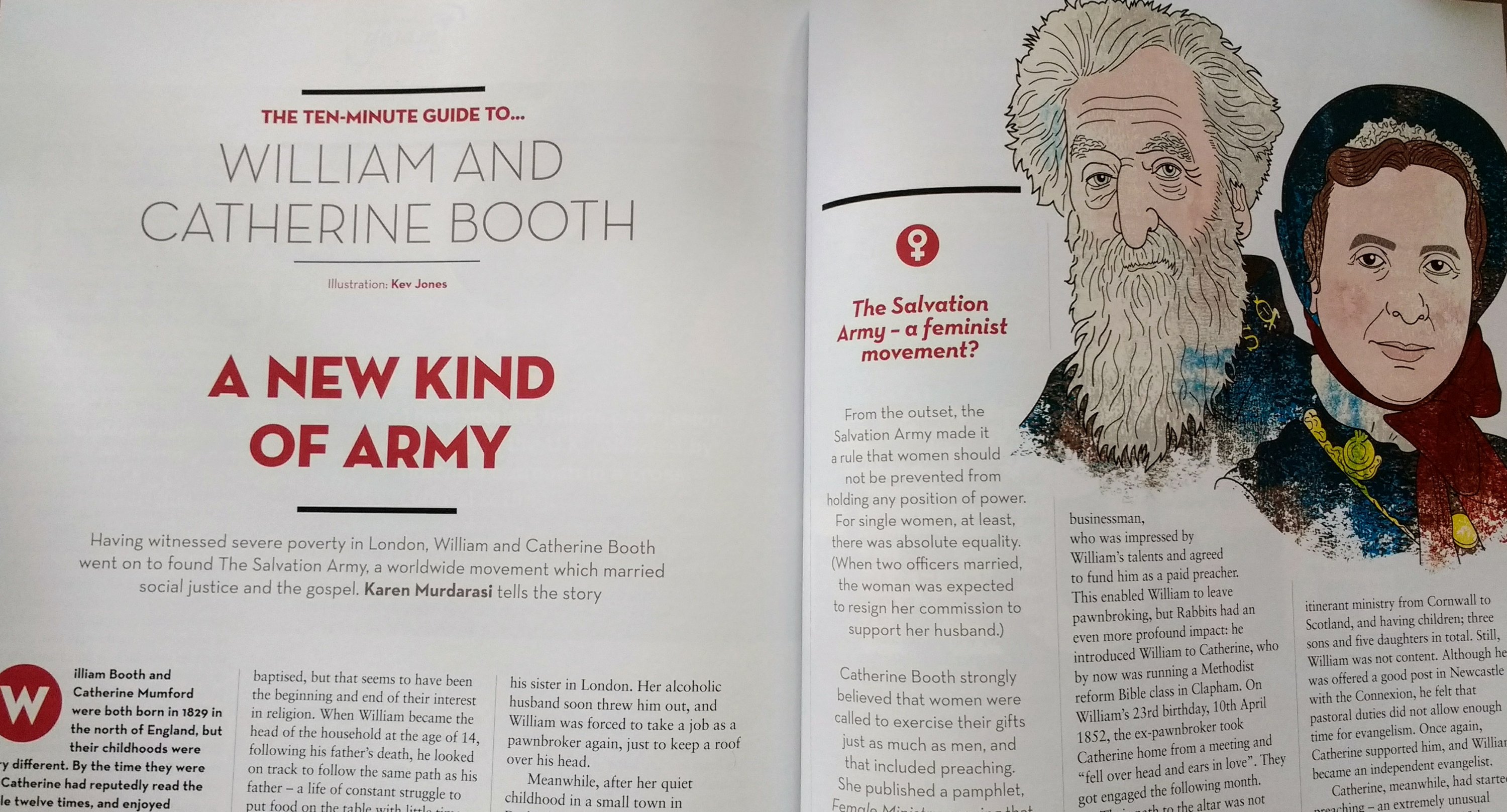
The August edition of Premier Christianity magazine features my article on William and Catherine Booth. If you’re thinking “who?”, they were the couple who set up The Salvation Army, back when the English capital was a lot grimmer than it is now – “the London of Charles Dickens and Jack the Ripper” indeed. 

Pick up a copy in larger newsagents, or get a free copy online. 

Get my books for free!

21 Jul

Much as I love being paid for my writing, I do occasionally take part in promotions like the Smashwords Summer Sale. That means you can currently get Leda, Office Life (and Death) and A New Year’s Trio for free as ebooks, as well as Running for Cover, a short story, which is always free.

See all the books, and my author interview, on my Smashwords profile.

By the way, I’ve just had my annual author photo taken, courtesy of Studio Genti, Lushnje, Albania. What do you think?

The Power of Purple

14 Jul

If you’re dyslexic, you’re close to a dyslexic, or you’re just the curious type, you may want to read my latest blog post for Dyslexia Scotland. Its working title was “Methods of alleviating the symptoms of dyslexia”, but fortunately I came up with something slightly snappier 😉 

https://alifelessordinaryds.wordpress.com/2017/07/14/the-power-of-purple/amp/

A-maze-ing Graffiti Art at SWG3

3 Jul

Another photo post – give the people what they want.

The story behind this is that I was at ‘Hypermarket’ this weekend at SWG3, an arts space behind the railway arches off the Expressway (if you know Glasgow at all). It wasn’t terribly ‘hyper’ – in fact it was a small-to-medium craft fair marooned in an over-large space, with a half-hearted selection of overpriced “street food” outside in the courtyard, under a dull grey sky.

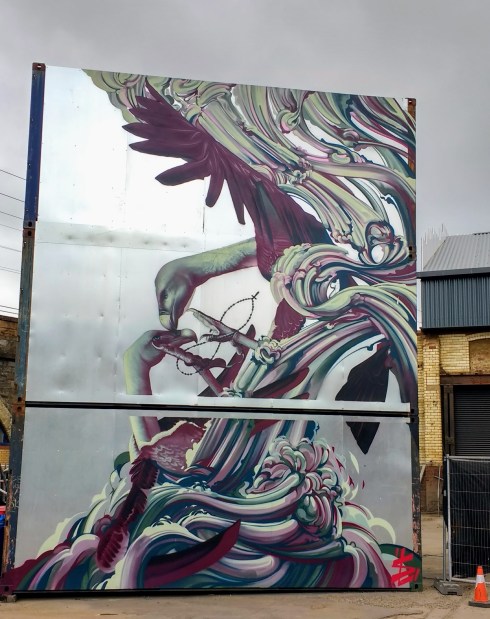
I didn’t stay long, but while I was there I took the opportunity to photograph the one stand-out item of this whole setup: the graffiti art. There were walls and walls of it, freestanding, arranged into a sort of not-very-challenging maze, as you can probably see from this picture.

My favourite was this picture of ?vultures, painted on sheets of metal – appropriate for an old galvanizing yard.

I liked the joke on this Billy Connolly one. There’s a lot of Billy Connolly art around Glasgow at the moment, since he’s just turned 75.

This fish took me a wee moment to work out at first.

And I still haven’t worked this one out.

Or this. It really looks like a word, but I don’t know what it says. Answers on a postcard (or in the comments below).

There were others, if you want to pop along (check the SWG3 website for events) but these were my favourites.

And finally, the credits (I don’t know which name applies to which artwork, but I’m sure you know how search engines work.):

O For 6,000 Hymns to Sing! 

30 May

I just got my copy of the June edition Christianity magazine through the post this morning, because I have an article on the Wesleys in it.

John and Charles Wesley had very interesting and effective lives – especially the indefatigable John, although I get the feeling that I would have much preferred Charles, if I had known them. 

Charles wrote a bucketload of hymns, of course, including O! For a Thousand Tongues to Sing (as you probably gathered from the title), and the one currently on repeat in my brain, Love Divine All Loves Excelling. If I have managed to get one of his hymns stuck in your head, too, do comment and let me know which one 😉 

Anyway, the magazine should soon be in sale in larger newsagents, if it’s not already, or you can subscribe online. You can even get a copy free, if you’re not a subscriber yet. There’s an interesting-looking article on purgatory (I haven’t read it yet) as well as my own work and usually lots of other good stuff, so you may as well. 

Enjoy! 

How Not to Read Books

12 May

A shipment of freshly-printed copies of The Talisman

This week, with some relief, I returned The Talisman to the library. It’s a fantasy novel by Stephen King and Peter Straub, roughly the size of a breeze block – and I hadn’t finished it.

There was a time when I hardly ever left a book unfinished, no matter how little I was enjoying it (I’m looking at you, The Lord of the Rings) and when I did, I felt bad about it. I’m a quick reader, so it was usually a case of lack of desire rather than lack of time. These days, time is harder to come by so the quality of the book (or to be fairer, my enjoyment of it) have become more important.

I’ve recently got into the KonMari school of tidying and organising, and discovered the deeply soothing quality of an organised sock drawer. One of the ideas of KonMari is that you should throw out books, which sounds scandalous to a book lover, but when I read on, I could see Marie Kondo’s point. Why keep books you are never going to read (or re-read) and that just stare at you sadly from the bookshelves? If it’s because just seeing them makes you happy, great. But if it doesn’t, why are they taking up valuable bookshelf space?

My sock drawer is a small oasis of order

So quite a lot of my books recently went off to Music Magpie, and others are going to find their way to charity shops in the near future. Some of them I had started but never read. Some of them I hadn’t even started, and knew I probably never would. Getting rid of them is not failure; it is liberation.

In that spirit, here are some books I have left part-read, and the reasons why. Feel free to use the comments to give me your own list.

*

The Talisman, Stephen King & Peter Straub

It is just. Too. Long. That’s not a problem in itself, but when nothing much happens for several hundred pages, and what happens is fairly repetitive, it is a problem. This is especially true when any action present has an unsettlingly sadistic feeling to it. I’ve never failed to finish a Stephen King book before, but this just wasn’t worth the effort. The addition of a semi-human bit of – what? comic relief? – doesn’t improve a long book either, whether it’s a werewolf or an anthropomorphic countryside spirit. (Yes, I’m looking at you again, LOTR. Tom Bombadil should never have made the final edit.)

*

The Lemon Tree, Sandy Tolan

This is not a bad book. In fact it’s very informative, and quite well written. But the author’s insistence on not straying beyond the recorded evidence at all, even for emotions and motivations, eventually makes this non-fiction, novel-ish book unengaging. I know it’s trying to keep cool about an inflammatory subject (the Israel-Palestine conflict) but in the end it was just too cold to hold my attention. Non-fiction novels can be done better than this; just see Truman Capote’s In Cold Blood. That leaves you chilled, not frigid.

*

The Celestine Prophecy, James Redfield

This was only vaguely interesting at the start, and became less so as it disappeared deeper up its own worldview. The protagonist experiences spiritual and psychological insights which don’t seem to amount to much in terms of a system of universal truth (spot my western post-Enlightenment bias there) but are so enthralling to him that he must talk about them, at length, while nothing much happens. Then men with guns turn up, he escapes, goes somewhere else and has another insight. Repeat ad nauseam. Real psychological and spiritual insights, I like (try looking up Jordan Peterson’s Maps of Meaning lectures on YouTube for that sort of thing) but this was not my cup of enlightened tea at all.

*

The Fall of Lucifer, Wendy Alec; The Shack, William Paul Young

I’m lumping these ones together because, while they’re dissimilar in some ways, they are both based on Christian (or thereabouts) theology, and they are both really bad. I mean truly, truly appalling. I couldn’t get further than the first chapter of either of them. The writing was so bad it was almost physically painful. I may be a bit hypersensitive when it comes to bad writing, but the very thought of reading these books makes me shudder.

Again, this can actually be done well. This Present Darkness by Frank Peretti is about a hundred times better than The Fall of Lucifer – and that’s a modest estimate.

***

I don’t think these are the only books I’ve rejected. I have a strong memory of throwing a book across the room when it irritated me one time too many, not so long ago (I know, I know, violence against books should never be condoned), but I can’t remember which one it was. Maybe it will come back to me, and I will add it to my list. In the meantime, let me know which books you have rejected, and why, in the comments below.

The Archaic Smile

15 Apr

Just a quickie to say that my short story ‘The Archaic Smile’ has been published on The Ogilvie literary review. It is free to read online, so go and have a look.

The story is about an archaic kouros – that’s a type of Greek statue (like the one in the picture to the left), but it is more eventful than you might think for a story that has a statue as its hero. The Ogilvie said it had ‘subtle prose and artful suspense‘ so really, go and read it!

The Art of Complaining

3 Apr

“I couldn’t sleep a wink!”

One of the joys of helping to look after my little nieces is getting to revisit things from my childhood. Last week it was paperchain people (try them with monkeys – it’s really cute!) but the week before that it was the Princess and the Pea, the Hans Christian Andersen story about a girl who arrives at a castle in a storm, claiming to be a princess, and whose royal pedigree is proved by her feeling a dried pea through 20 mattresses.

Coming back to this story many years on, instead of dwelling on how ridiculous this is (and it is), I instead found myself thinking, “Of course complaining about a pea in her bed shows she’s a princess. If she was a nice, middle-class girl she wouldn’t dream of complaining!” I mean really, if you were taken in on trust, out of a storm, alone and helpless, would you tell your host the bed was lumpy? I wouldn’t lie about it, but I’m sure I could find something more positive to say than, “I couldn’t sleep a wink all night!”

This got me thinking about complaining more generally. In Britain, we’re traditionally not supposed to be very good at complaining. To be more accurate, we’re very good at moaning about things, but we would rather die than complain to anyone who can do anything about it, like a waiter or shopkeeper, for example. Perhaps we might write a stiff letter, but never say anything to anyone’s face.

This is a Very British Problem, judging by the Twitter account of the same name, which is extremely funny. (It’s also available in book form for those who aren’t into social media.) This is also one of the areas where I’m not very British, perhaps as a result of spending too much time overseas (or it could just be my personality). I am fairly likely to complain if something isn’t right. I spent 15 minutes in Superdrug the other day trying to return some hair chalks that only cost about three quid, on the principle that if you buy something, it should work. The complaint has been forwarded further up the chain of management. By the time I get my three quid back (if I ever do) they will probably have devalued to the equivalent of 30p due to Brexit.

Maybe I shouldn’t have bothered. But there are some things you are supposed to complain about, or at least not sit on. I often find I’m annoyed by some insignificant thing someone has done again and start thinking, “He/she knows I hate it! They’re doing it to annoy me!”, only to realise that I’ve probably never told them I hate it, and they are blithely oblivious to my irritation. In a situation like that you either have to say something, or learn to live quietly with the annoyance, rather than explode in rage when it happens for the tenth time.

Addictions are another situation where you’re supposed to complain, according to official advice. Without going into any detail, there are some addiction/dependency ‘issues’ in my own family, and while a public blog post isn’t the place to drag them out, it’s not something I keep from my friends. In such a situation, silent forbearance probably makes things worse. But there is probably a level of willingness to complain that lies somewhere between doormat and drooket fairytale princess, which is healthy and practical without being self-centred. With that in mind, here’s a slightly altered version of the well-known Serenity Prayer:

God grant me the serenity to shut up about the things I ought to put up with,
The courage to complain about the things I ought not to,
And the wisdom to know the difference.

(If you’re into Hans Christian Andersen, by the way, check out my lovely audio version of the Snow Queen, narrated by Sophie Aldred.)