Archive | Observations and musings RSS feed for this section

The Five Types of Ceilidh

1 Feb

I was at a ceilidh in Ayrshire the other night (don’t worry, I’d had the necessary inoculations). It was a small, cozy affair and it set me to thinking about the various kinds of ceilidhs that occur. The following list is probably not complete, so feel free to chip in using the comments section.

(Before I go any further, though, I should probably explain for anyone who is not in touch with their Scottish side that a ceilidh is a social event where people do, or attempt to do, traditional Scottish dancing. Yes, folk dancing is alive and kicking in Scotland, although it doesn’t features handkerchiefs or bells, thankfully.)

1. The Family Ceilidh. We’ll start with this because it was the type I was at most recently. This is a ceilidh held by a small group, such as a church or club, in a small (often much too small) venue, involving small people, since this is the type of ceilidh that kids attend with their parents.

What a family ceilidh is like depends very much on the group it’s composed of, and on whether you’re part of that group. At my own church a small, intimate ceilidh seems warm and friendly, and the children adorable. At an alien church or group it can feel a bit like wandering into a locals’ pub, where everyone knows you’re not from round here, and the children are worrying trip hazards. Norms of ceilidh etiquette also seem to vary considerably between groups; it will take me some time to get over the experience of being turned down by three men in a row for the last dance in Ayrshire!

Pros: If you’re local, you get a warm fuzzy, included feeling, and if you’re a kid there are patient people prepared to suffer backache in order to partner you in a dance.

Cons: If you’re not local you can feel a bit exposed and socially incompetent, although rumours of stonings are probably exaggerated.

2. The Beginners Ceilidh

This is probably the most common type. I’m using this term to refer to ceilidhs where a significant proportion of the dancers are newbies and the dances are not only called (i.e. instructions are given during the dances) but usually walked through for practice, too.

Beginners ceilidhs are necessary, because so many people want to try out a bit of Scottish culture, and you have to start somewhere, but there’s a sort of critical mass they can approach, where there are too many people who don’t know what they’re doing in proportion to those who do, and what you get is not so much a dance as a musical game of blind man’s buff without blindfolds.

The Eightsome Reel, one of the trickier dances, is particularly susceptible to this numbers game. If at least 5 of the dancers are experienced (including at least one in each couple), you’ll probably be fine. Any fewer and the Grand Chain turns into the Grand Guddle.

Pros: Friendly, welcoming, good for learning the dances, good for meeting new people.

Cons: A bit slow and boring if you do know what you’re doing. Potentially messy, and often overcrowded. Potential for minor injury.

3. The Enthusiastic Ceilidh

This is a type of ceilidh I often went to at university. It’s the type where the vast majority of people are at least moderately experienced, and some have been dancing since they were able to walk. The age profile also tends to be youngish.

Dances at this type of ceilidh aren’t boring, mainly because the difficulty level is raised by an increase in speed, the addition of twiddly bits (extra turns, different holds), and occasionally by sheer recklessness. (I was once at a ceilidh where all the girls in my set decided to change to another set in the middle of the dance, without warning the men. Or the other set.)

Fun though enthusiastic ceilidhs are, they’re not great if you’re a beginner, or physically infirm, or afraid of injury. Bruises on your arms are the least you can expect.

Pros: The best fun you can have in a chilly hall (it won’t stay chilly for long) or ruined castle. Great exercise and mentally challenging too.

Cons: Beginners and older people can get left behind. Potential for serious injury.

4.The Professional Ceilidh

When I say professional, I don’t mean anyone is necessarily getting paid for it, but you’d think they were, the amount of care, attention and exactitude that goes into the enterprise.

These ceilidhs tend to be run by Celtic societies or Scottish Country Dancing clubs. The age range is often post-retirement or thereabouts, and a very dim view is taken of whooping, falling over and, I expect, swapping sets mid dance.

A professional ceilidh is where you should go if you want to see what the dances are supposed to look like, without beginners’ mistakes and enthusiasts’ messing about. It is likely the only place you will ever see The Duke of Perth danced right through without people getting confused and giving up halfway.

Even the steps are performed correctly, from the ‘setting’ to your partner (a sort of skip and kick) to the circle step to the skipping step to get from one place to another, when most people just walk. They can even polka properly!

There’s something to be said for professional ceilidhs. There’s a lot of knowledge preserved in those gently bobbing grey heads that might otherwise be lost, they are entirely free of irritating beginner’s mistakes, and it’s satisfying to sometimes reach the end of a dance just as the music ends, and know you’ve done it right. But they’re a little staid for my taste. Maybe I’ll appreciate them properly when I’m older, but for now I still like to spin too fast, whoop too loudly, and invade other sets during the Virginia Reel.

Pros: Accuracy – extreme accuracy. Almost no potential for injury.

Cons: Pretty dull, and a bit disapproving.

5. The Impromptu Ceilidh

The rarest of all types, but not mythical. There’s a magical combination of ingredients, including a group of Scots, suitable music, a late hour and, usually, a certain quantity of alcohol, that can result in people grabbing one another by the crook of the elbow and launching into some Scottish dancing.

These are probably the least correct of all ceilidhs; the sets are usually the wrong size, there often isn’t enough space, and no one’s announcing the dances so people can be doing a different dance from the rest of the group, and indeed from their partner. It can also very easily descend into maudlin singing of Caledonia or raucous chanting of Flower of Scotland as the night wears on. But there’s something wonderful about ceilidhs that just spring from thin air because you want to express your joy through dance and, since you come from a culture that has a national style of dance, you can.

No doubt there are other ways of categorising ceilidhs, and there may be some types I have not experienced yet, but for the time being, these are the five different types of ceilidh I have attended. And I have the bruises to prove it.

Gaudeamus igitur linguam latinam dum loquimur

28 Dec

(Let us rejoice, therefore, because we speak Latin.) Christmas is one of the few times that speaking, or at least singing Latin is commonplace. You may well have belted out the words “gloria in excelsis”, “in dulce jubilo” or (if you’re hardcore) “adeste fideles” yourself this festive season. While teaching the Sunday school about Christmas I noticed how ubiquitous it is at this time of year. “What does ‘advent’ mean?” “It’s from the Latin for ‘arrive’.” “What does’ nativity’ mean?” “It’s from the Latin for ‘born’.” And so on. It’s not just in church that you find Latin though. There are bestsellers other than the Bible that benefit from a little Latin magic – literally, in the case of Harry Potter. Most of the spells taught at Hogwarts are just instructions in slightly mangled Latin, and there are secret wee clues on the books for Latin speakers, too. I was kicking myself when I discovered the secret about Remus Lupin because it was there in his name all the time. J K Rowling isn’t the only author putting her classical education to use. The author of The Hunger Games, Suzanne Collins, uses a lot of Greek and especially Roman references, particularly in the names of Capitoline characters. When I found out that the name of Panem, her fictional land, was from panem et circenses, bread and circuses – the only things the Emperor Tiberius said Romans cared about – it gave me a lovely satisfied feeling all day, it was so right. The moral, clearly, is if you want to write a best-selling book for younger readers, speak Latin. In all seriousness, though, Latin is amazingly useful. I often say that it was the most useful subject I ever studied (barring reading, writing and arithmetic, which are the sine qua non of any education) and that’s no exaggeration. In Latin classes I learnt not only how to read Latin (although that’s sometimes handy) but also European history and geography (which weren’t really covered in History and Geography classes at that time, due to the vagaries of educational fashion). I picked up the bones of all Latin languages, so that I have an advantage when it comes to understanding Italian, Spanish, French, Portuguese and even Romanian. What’s more, by studying a dead language I learnt how to take a language apart, understand its components, and put it back together again. That has made it so much quicker and easier for me to pick up any language, as well as making my English grammar pretty much impeccable – no bad thing for a writer. Latin classes were also my first introduction to another culture, one that still fascinates me now. It was because I enjoyed GCSE Latin that I went on to study Classical Civilisation at A Level, and then Ancient History at university. If I hadn’t learnt Latin I might never have met my darling Alexander, and would almost certainly not have written my new book Augustine: The Truth Seeker. It’s no exaggeration to say that the course my life (my curriculum vitae, if you like) would have been quite different if I had never studied Latin. For centuries, Latin was the international language, spoken by all educated people (although admittedly the proportion of people who were educated was a lot lower than it is now). All those old documents and inscriptions in Latin were written not so that people couldn’t read them, but so that they could. With a knowledge of Latin you could study at any university in Europe in the Middle Ages, because that was the language they all taught in. Even today, the University of St Andrews (my alma mater) uses Latin in its graduation ceremony, so that I became a Master of Arts by the use of the secret magic words “et super te”, or Super Ted, as we liked to call it. These days, Latin is a bit of an elite pursuit, usually available as a subject only at private schools. I think that’s a terrible shame. Such a useful subject (and an enjoyable one, if you do the Cambridge Latin Course) should be available to everyone. So if you ever do get the chance to study Latin, seize it! Or to put it another way, carpe diem! For those of you who already speak Latin (or rather, read it, since conversational Latin isn’t very useful), here’s a wee Christmas treat to make you smile: image

Train of Thought

25 Nov

I am writing this on a train. That sentence probably didn’t alarm you.  It might have done if I had instead written “I am writing this while driving a car.” That’s just one of many good things about public transport in general, but trains more specifically. I have been left in charge of the car keys recently and have had occasion to do a bit of driving, and while cars are certainly convenient and at times almost necessary, it has made me realise just how much I like trains, how relaxed they make me feel in comparison with the heart-palpitations-and-incipient-ulcer sensation I get when discovering that I’m in the wrong lane with no idea how to get to my junction.

Certainly, trains have their faults. They’re almost a by-word for lateness, they are sometimes crowded, and it’s not much fun being on the last train home on a Saturday night with all the people who are too drunk to drive, and far too drunk to regulate the volume of their conversation. However, those things are also true of buses, which are far less pleasant to travel on. So this post will be all about the superiority of trains as a form of domestic transport.

Five reasons why trains are better than cars

1. You don’t have to scrape the train on a cold morning, and the heating is already on when you get in.
2. If the train breaks down, you don’t have to pay to repair it.
3. Trains are almost never in the wrong lane, and can’t ever take the wrong turning because they’re on rails.
4. No one tailgates you on the train.
5. You don’t have to park a train.

Five reasons why trains are better than buses

1. Buses have to stick to roads. Trains often go through some of the most beautiful countryside, without any other traffic to scare the wildlife away.
2. Trains don’t take unannounced diversions and leave you in an unfamiliar part of town with no idea how to get to where you’re going.
3. You don’t have to go to each platform to find out which one your train will stop at; there will be a sign in a central area telling you which one. Not so with bus stops.
4. People on buses (in the aggregate) are louder, smellier and more aggressive than on trains. I don’t know why, they just are. Bus drivers also tend to be less friendly than train conductors. Maybe someone should do a sociological study.
5. Trains are great for writing on. It’s something about the white noise, rhythmic motion and view out the window. It seems to switch off certain parts of your brain in a really helpful way. Buses don’t have the same neurological effect, and anyway all the bumps mean you would never be able to read your writing anyway.

I’m crossing a misty river in perfect comfort, watching the stressed traffic driving along the bank below me, which means I’m almost on Central Station. Time to sign off.

The Book of Hezekiah

18 Oct

I am in the process of organising a ceilidh. (23rd November at Adelaide Place Baptist Church, do come along if you’re in Glasgow.) Finding a date that worked for the venue and the band, and didn’t clash with any popular events or holidays, was a bit complicated and protracted, and no doubt there will be all sorts of headaches to come about layout, first aid provision, audio, catering and so on (in fact I’m giving myself a headache now just thinking about it). However, one thing that I didn’t have to give any serious thought to was the start time: 7.30pm, of course, as is prescribed in the Book of Hezekiah.

Hezekiah is a book of the Bible that contains all sorts of useful instructions and information about Christian living. This is where it says (in chapter 3, “Times and Seasons”) that morning church services should be held at 11 (or 10.30, at a pinch) and evening ones at 6.30, but that all other evening Christian events (or in the case of the ceilidh, events with Christian venues and / or organisers) should start at 7.30. This chapter also lays down the exact amount of time one should remain in one’s seat after the service, depending on the solemnity of the final hymn, depth of the sermon and proximity to communion (Eucharist), before one can make a foray towards the biscuits.

If you’re of a religious persuasion at all, you may be wondering where Hezekiah is in your Bible, and why you’ve never come across the 7.30pm rule written down. I mean it sounds familiar, but you can’t quite place it. Minor prophets, maybe, all those tiny books tucked away at the end of the Old Testament that you only come across accidentally when trying to find the start of Matthew at Christmas? Or, if you’ve gone so far as to check the contents page of your Bible and find it’s not there, maybe it’s in the Apocrypha, that land of exotic and forbidden scriptural delights?

No, I’m afraid the Book of Hezekiah, while very useful, doesn’t actually exist. It’s just a Christian joke, but one with a point. It’s an unwritten record of our shared assumptions and habits. Tea and coffee should be served after the service, not port and sherry. Why? Because thus is it laid out in Hezekiah 5:12. It should be served by women, of course, as is prescribed in the following verse. Women must also lead the Sunday school and clean the church, of course. The Book of Hezekiah’s not great on gender liberation. These instructions may change in the future. One of the unusual things about Hezekiah, compared to other Bible books, is how it alters its content from one generation to the next.

Then there are the moral precepts that you know are right, but that you just can’t find anywhere else in the Bible, like the prohibition of gambling or the command not to lie. Yes, the ninth commandment almost says you shouldn’t lie, but not quite, so you need the Book of Hezekiah to fill the gap. This is less of a problem for Catholics of course, who can draw on both scripture and tradition. Protestants (like me) base their beliefs, in theory, sola on scriptura, meaning that when scripture lets you down, you have to turn to Hezekiah.

Now I’m not saying that you should lie and gamble. Nor am I advocating a departure from the authority of (real) scripture, although it is worthwhile to bear in mind that while Bible+ has its dangers, the sola scriptura approach also has potential weaknesses. No, what I’m saying in a rambling sort of way is that you should question your assumptions, even if everyone else in your church holds the same assumptions. What are they based on? If you don’t know, maybe you should find out, and decide whether or not you should keep them.

“For in the critical examination of the assumptions, wisdom is found,” as it says in Hezekiah 1:6.

(But the ceilidh will still be at 7.30pm – I’ve printed the tickets.)

Glasgow Details

18 Sep

My previous photo post on Glasgow’s grafitti art proved rather popular. As a writer, this leaves me with mixed feelings: happy that people are reading my blog, perturbed that more people read it when there isn’t much actual writing. Hmm. However, stiffening my British lip and trying not to be offended, I have decided to post another lot of photos. (Click on any of the photos to see a larger version.)

Glasgow is, of course, swimming in great architecture. In fact you can barely tell one beautifully proportioned Georgian street from another when you’re in a hurry, and the looming, ornate Victorian piles have a tendancy to blend into one another after a while. (If you’re reading this thinking “Isn’t Glasgow a big industrial dump?”, do your research. Or better yet, come and visit.)

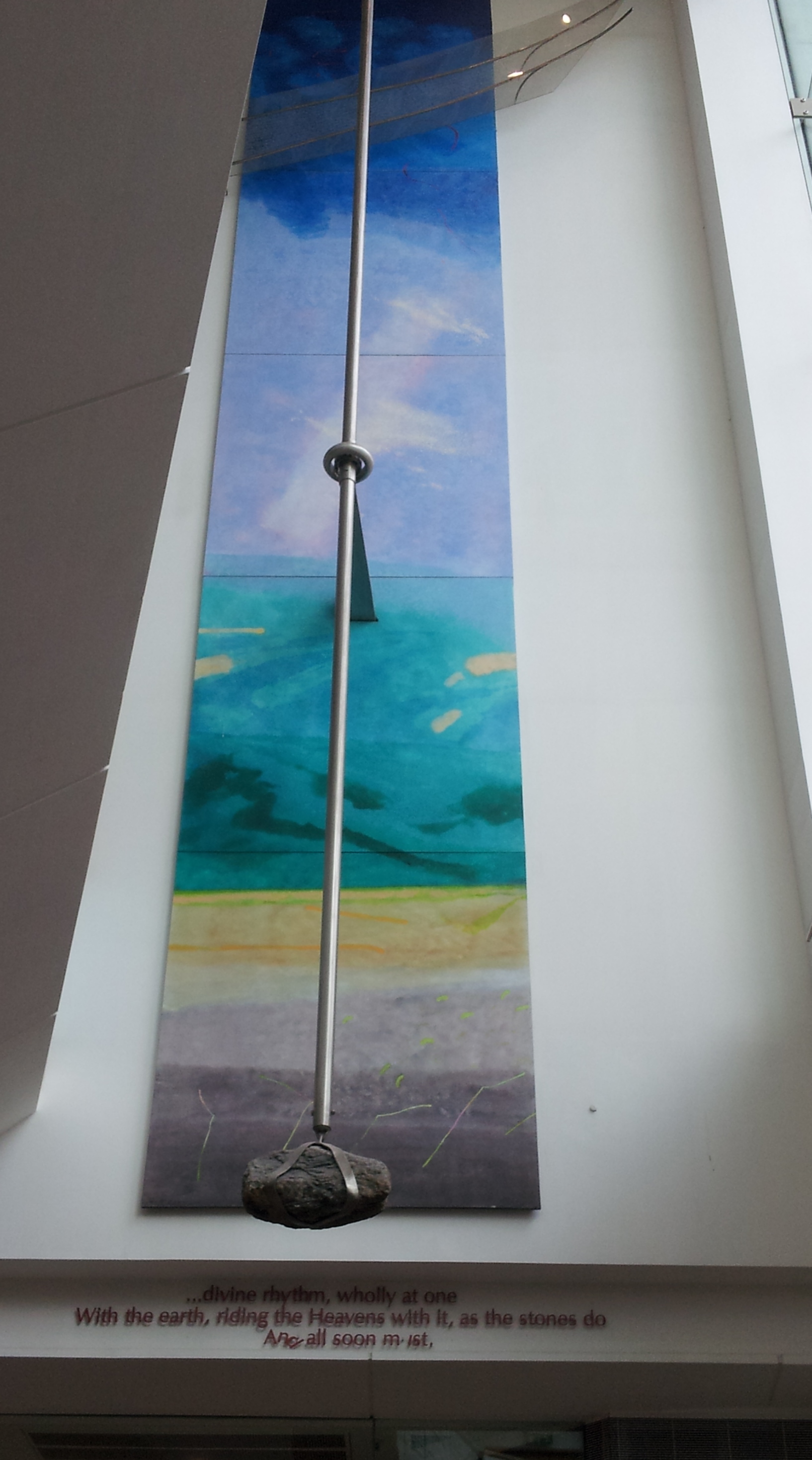
These photos are of some of the nice wee details in Glasgow city centre that often get overlooked – things we ought to appreciate more. For instance, there’s a lovely new piece of artwork in Buchanan Galleries that people don’t tend to see much of as they rush towards the escalators on their way to Boots.

divine rhythm, wholly at one With the earth, riding the Heavens with it, as the stones do, And all soon must.

…divine rhythm, wholly at one
With the earth, riding the Heavens with it, as the stones do,
And all soon must.

The central Post Office, on St Vincent Street, is rather impressive if you have the time to stop and appreciate it.

20130916_121140 20130916_121109 20130916_121103
Even Central Station’s not bad. A Dutch friend said it reminded her of Hogwarts! (An aside: Central’s not much like Hogwarts, actually, but the wood-panelled, stained glass dining room of St Salvators Hall in St Andrews really is. If it had been any closer, food would have appeared by magic. And tasted nice.)

20130916_122612

To be fair, you probably have noticed Central Station. It’s not exactly a detail (though I like the wrought iron working in this photo). But what about the giant metal peacock in the middle of Buchanan Street (above Princes Square)?

20130916_121416

And probably my favourite detail of all: baby dragons outside 200 St Vincent Street. Why? I don’t know, but they’re adorable.

20130916_123025

Do you have any favourite overlooked details of Glasgow? Please add a comment!

What you think, you are.

19 Aug

If I hadn’t lived in Albania I would have been very confused by the way my Italian lodger empties the dishwasher. Glasses, pans and spoons pose no problem, but bowls are placed on a pile of plates, and plates on a pile of bowls, totally at random. Wooden spoons and spatulas find their place, but kitchen knives are nestled next to table knives.

Because I lived in Albania, where they obviously have a similar approach to cutlery and crockery, I know that he didn’t just get fed up half way through and stop caring where he put stuff. Instead, if his culture is like Albania’s, it makes no distinction between plates and (eating) bowls, or between kitchen knives and table knives. To fit out our kitchen in Tirana we got a pile of shallow bowls which served for everything from soup to bread and jam, and after searching in vain for proper table knives we got a packet of the awkward plastic knives that everyone else had – too sharp to be safe at the table, too small and blunt to be useful in the kitchen.

What interests me about this is not so much what plates different cultures eat off (although I’m sure there’s a PhD in there for someone), but the way our cultural assumptions affect the way we think,  behave and even see. My Italian lodger has perfectly good eyes and, if he stopped to think about it, could see that there is a pile of flat plates next to a pile of concave plates, but since he thinks of them all as plates, he doesn’t see it, so he slots them in at random. Similarly, in his mind knives are knives, so the fact that there is a cutlery drawer and a separate utensil drawer gives him no pause.

This sort of thing is often connected to language. In Albania, ‘pillow’ and ‘cushion’ are the same word, and people do seem more ready to use cushions as pillows than they would be here. A dislike of moths combined with a liking for butterflies strikes people as illogical, since they are both flutura.

It works the other way round, too. To me, there are different kinds of brushes but they are all still brushes. In Albanian there are two distinct words, so you have to think about what you’re using the brush for. Is it a sweeping motion (fshes) or a scrubbing / stroking motion (furce)? When you ‘change’ something, are you exchanging one thing for another (nderroj), or changing the form or substance of the thing itself (ndryshoj)?

All very boring if you’re not interested in comparative linguistics, I’m sure, but it has an application in our own language as well. There’s no male equivalent of ‘slut’, for instance, or any of its many synonyms. Also, ‘mistress’ might be the feminine equivalent of ‘master’, but it does not mean the same thing. There are well-known derogatory terms in British English for most ethnic groups, but not for white people. These things might seem tiny, but they do colour our thinking, because words are the tools we use to think about the world; they are the lens through which we see it. It is a good thing to be aware of the deficiencies of your lens.

George Orwell understood the power of words when he described “newspeak”. You can read about it in Nineteen Eighty-Four, a brilliant but disturbing book.  You can also hear newspeak in real life, if you keep your ears open, especially when listening to politicians. (‘Efficiencies’ for ‘cuts’ would be one example.)

As for the title of this post, it comes from an excellent quote attributed to Methodist minister Norman Vincent Peale:

“You are not what you think you are. But what you think, you are.”

Cloudy, Chance of Rage

29 Jun

sivvus_weather_symbols_6
Without wanting to give away too much about my age, I remember computers before Windows. If you don’t remember that, it’s hard to even imagine it. I know that there are all sorts of interfaces now, and many people are critical of Windows as an inferior system, but whenever people complain about I wish I could sit them down in front of a black screen with a green flashing > and say to them, “Go on, make it work. Oh, you don’t know the commands? TOUGH!”

Now, I’m not in the pay of Microsoft, and I don’t know a huge amount about computers. I just “mmm” vaguely when people talk about the superiority of Linux, because I really wouldn’t know (although I’m very much not a fan of Apple, albeit for reasons that generally don’t have much to do with their software). The point I’m trying to make, though, is how amazing the modern interface is. You click on the wordprocessing icon with your mouse, the word processor opens on your screen, you click somewhere in the text and start typing. Let’s break that down a little:

You use your mouse to move an arrow that isn’t really there (it’s just different pixels on the screen changing colour giving the impression of movement). You use it to click on an icon that is also just some differently coloured pixels on a screen. From this your computer is able to tell which program you are trying to open, even if you moved that icon halfway across the screen only seconds before. When you open the menu (which conveniently has little words like “open” instead of requiring you to input the computing commands you don’t know) and request a file it will trawl its digital depths to retrieve reams of data which it then presents on-screen in the form of a typed document. But it’s not a typed document, it’s lots of incomprehensible binary data just pretending to be a sheet of paper and some ink. Then, when you move your non-existent cursor over the imaginary document it is able to tell where amongst the words that are not really there you have selected, and when you type it updates its confusing string of data in such a way that more pictures of typed letters appear on the screen exactly where you want them. 

I do it every day – I’m doing it now – but when I stop to think about it, it’s still amazing.

However, all this not-really-there-ness has a downside. You can lose a paper document, of course. You can rip it, spill coffee on it, accidentally set fire to it. The ink may even fade over time until it’s impossible to read. But it won’t disappear in a puff of smoke. That’s exactly what can happen to digital files, though, and it happened to me today.

Now before anyone starts to wag a finger at me and talk about backing things up, I did, and that was what caused the problem. I backed up the completed manuscript of my children’s biography of St Augustine in a cloud-based storage facility. That takes not-really-there-ness to a whole new level. I can open files on my computer now, that not only aren’t really words on paper, but aren’t even complicated data on my computer pretending to be words, because they’re not on my computer at all, they’re only hovering there in an insubstantial, wraith-like way, while the actual data is on a server far, far away. Too far away to kick when it manages to eat the last hour of work you’ve produced.

All was not lost, however, as I eventually managed to restore a “conflicted” file that turned out to be the proper file, but there was much ranting and raging up to that point. It makes you feel so helpless. I searched for different versions of the file, I searched for words that I knew were only in the completed version, but the computer kept telling me it did not exist. It also makes you question your sanity. “But I saw it!” I kept saying to the computer. “It was there! I typed it! I did!” If it hadn’t been for the presence of a friend who saw the finished version, I might have started to doubt it myself. After all, there’s no evidence, no inky marks on your thumb, no impression of the words on a writing surface or another piece of paper. There’s just the computer telling you that the collection of data you spent hours tapping away at does not exist. And if it says so, it’s right, because these things only exist by the grace of the computer. I may have made this point before, but digital documents are not real. It takes you right back to that feeling of helplessness facing the flashing green > without the proper commands.

At some point in the next six months, that errant electronic manuscript will become a real, paper-and-ink book, and then it will be a lot harder to make it vanish. Until then, perhaps I should just try the form of paper-based storage known as printing.

A Walk on the Child Side

8 Jun
Getting out in the sunshine - just one of the advantages of kids.

Getting out in the sunshine – just one of the advantages of kids.

For the last year and a half I have been looking after my wee niece, since giving up the office job at the start of 2012. Now my sister is on maternity leave again and my services are temporarily not required. It seems like a good time to review this period of my life. It has certainly been challenging, financially, emotionally and at times physically, but I want to focus on the positive aspects, since they far outweigh the negative ones. Looking after my niece has been for all intents and purposes like being a parent, albeit part-time. So here are the best things, in my opinion, about having small children.

1) Getting outdoors. One of the worst things about a nine-to-five, Monday to Friday job is that you have to languish in poorly air-conditioned rooms on the best days of the year, and by the time the weekend comes the hot spell has almost always broken. Not so when you are looking after kids. You can kick a ball in the garden, go for ice cream, or play in the park. They do not get bored with playing in the park even when it is the fourth day in a row. Toddlers are good that way.

I’ve got far more fresh air and exercise these last few months than in the years before. Of course, I’ve also been rained on a lot because I can’t hold an umbrella and push a pram, but I think hours spent pushing a swing in the sunshine make up for that.

2) Kids are extremely portable. So are babies. This means that I don’t have to wait until the evening to go the supermarket, or the weekend to go to town. That’s not to say I made my poor niece tail around after me the whole time – mostly it was the other way round – but if I needed to go somewhere or buy something, or I just wanted to meet a friend, my niece could be popped in the buggy, or later just clasped by the hand, and taken with me.

3) Toddlers are easily amused. You’ve heard the one about how the wee kid always prefers the box to the present that came in it. That’s not necessarily true, but it is true that things like boxes, pieces of paper, handbag straps and train tickets can distract them for minutes at a time – which is good, considering their attention spans.

When my niece was a baby I didn’t need to take any toys with me when we went out because she would happily play with the clip and zip on my handbag for the whole train journey. Even now she’s happy to be read the same slim book again and again. Even housework is fun! If I sweep the floor, she wants to join in. I can kill quite a lot of time by getting her to help me hang up or take down the washing – and she loves it!

4) Kids learn so much! I am constantly amazed at the way my niece picks things up – and not just her, but all kids her age (although I reserve the right to think that my young relatives are particularly advanced). At first, of course, it’s just stuff like moving their hands in the direction they want them to go, then rolling, sitting up, crawling and so on. That’s interesting enough, if a little predictable.

Soon, though, they’re learning amazing stuff. When they learn to talk they pick up words all the time (so be careful what you say in front of them). It’s so exciting to hear my niece put together her own sentences from her own thoughts, insights into what’s going on in that freshly minted mind. I’ve written before about how she copies me putting on make-up and so on, but she also learns much more useful stuff.

From her Ballet4Babies class she had learned to plie and curtsey (sort of) and from me and her parents she has learnt her way round a kitchen. At two years and two months she can (with a bit of assistance) make coffee, tea, toast and scrambled eggs (!) and does a pretty good job of cutting out and decorating gingerbread men. If it wasn’t for the fact that she’s not allowed to touch the “burny” oven or pour hot water, she could set up in business as a caterer.

5) Kids love you. This is the best thing of all. When I arrive at the station to pick her up, cold, wet and scowling, my mood is immediately brightened by my niece’s smile of welcome. She’s genuinely pleased to see me, even though she only saw me the day before. She doesn’t care if I put her in the naughty place earlier for some misdeed, or that I’ve run out of yoghurt – well, actually she does care quite a lot about yoghurt, but she loves me anyway.

And now she has reached the point where she can tell people that she loves them, and can give kisses and hugs. It would melt the hardest heart. And the other day, my sister tells me, just before bed, she sleepily told her one-week old baby sister that she loved her. Adorable!

See? Wee kids are great.

Reading Corrupts, Watching TV Corrupts Absolutely

21 Apr

image

In November 1960 Penguin were found not guilty under the Obscene Publications Act over the publication of Lady Chatterley’s Lover. The book was judged to have sufficient literary merit to make up for the sex scenes and swear words. One of the questions famously asked by the prosecution was whether the jurors would want their wives or servants to read the book. As well as being rather patronising (some of the people on the jury were actually women), the question seemed to assume that only the weaker sex and the weaker-minded lower classes could possibly be corrupted by the book. Normal, middle class men were immune.

That was a long time ago and seems rather quaint (especially the bit about having servants). Now we have Fifty Shades of Grey which, they say, has no literary merit whatsoever, and certainly has a lot more sex. Despite their differences, though, the publication of 50 Shades would not have been possible without the acceptance of D H Lawrence’s book decades earlier. That’s probably not the kind of legacy the jurors thought they were leaving. In the fifty years or so since that trial we have gone from a time when a book could be banned for having sex in it to one where all TVs have several porn channels on them unless you choose to remove them.

It’s not a straight line from D H Lawrence to E L James, and I’m certainly not claiming that Lady Chatterley’s Lover is responsible for the downfall of western civilisation (although personally I don’t like Lawrence’s writing, and I think he had a very dodgy view of sexual relationships in general). If you want to trace the changes in western culture over the late century or so and you’re up for a bit of philosophy you should instead read Escape from Reason by Francis Schaeffer by Francis Schaeffer. That’s not what this post is about. It is about personal corruption.

This is something that has been on my mind since I went to a Royal Foundlings gig last month. Not that they are a corrupting influence – quite the opposite – but the lead singer said something about being careful what you put into your mind, and it got me thinking about some of the things I do consume, mentally, and the effect they have on me.

I’m not just talking about really horrible stuff that, once seen (or read) you wish you could un-see. (The book of American Psycho would fall into that category, as would the film The Change Up. I stopped both of them partway through, but too late to remove horrible images from my mind.) I’m talking about the more harmless-seeming but possibly more insidious stuff that subtly alters the boundaries of what you find acceptable.

I used to watch How I Met Your Mother, a light sitcom about a group of twenty-something friends, their struggles and relationships. The content is fairly tame, very pre-watershed, but the attitudes it espouses are more of a problem. I finally realised what it was that bothered me when I saw the blurb for a particular episode on the TV guide. It said that the main character, Ted, is really excited about his new girlfriends, until his friends point out that he hasn’t even slept with her yet. It wasn’t so much the premarital sex – a phenomenon hard to avoid in fiction or reality – it was the casual assumption that a romantic relationship is not valid until it’s sexual, and that anyone who would wait for marriage must be completely insane. It’s hard enough to live up to Christian sexual ethics at the best of times, but you just make it harder for yourself if you’re feeding yourself messages like these on a daily basis.

Then there are programmes that don’t actually espouse dodgy values, but just colour the way you interpret the world. I have a friend who is a lovely person, but has a rather negative, cynical attitude to – well, just about everything, and certainly all institutions or sources of authority. When I see the kind of things she watches on TV, her attitude become less surprising: it’s all documentaries about paedophile priests, child neglect and other types of crime and vice. These things go on, of course, but they are not the norm. Focusing on the negative makes you see things more negatively. To a large extent, you see what you expect to see – and the material you read and watch trains your mind in what it expects to see. (In fact there’s a wee Bible verse about that, if you’re interested.)

I’m not trying to pick specifically on How I Met Your Mother or depressing documentaries and label them as the source of all televisual evil; I’m just making the point that it’s good to be aware of the messages you are receiving from the material you read, and particularly watch (since it’s a more passive activity). Are there things you used to find shocking that no longer shock you? Are there attitudes that used to make you uncomfortable that no longer do? It’s all very well to say you’re becoming less narrow-minded, or prudish, or bigoted, or whatever other disparaging word you find most comforting, but the reality could be more disturbing. Your ‘harmless’ pleasures could be corrupting your morals and corroding your soul. We are more corruptible than we like to admit. An open mind is a valuable thing – but so is a vigilant one.

Singer Song of a Fiver

22 Mar

I feel another rant coming on soon (dogs, in case you’re wondering), so to avoid having two rants in a row and making you think I’m some sort of Mrs Angry, I’d like to stick in a wee paean of praise to my Singer sewing machine. I bought this little beauty for £5 at a jumble sale, hence the post’s title. I got it for a fiver because when the bloke selling it told me the price, which was £10, I replied,”Ten pounds?” incredulously, thinking “That’s so cheap!” He mistook my incredulity and said, “Ok, five pounds then.” I didn’t argue – I just called my husband to carry it home for me. (That’s what they’re for. That and killing spiders.)

The model I have dates from about the 1950s and is one of the earliest electric kinds, which is handy because I have never got the hang of a mechanical foot pedal. It is probably made of cast iron (although it feels like it’s made of lead), requires regular oiling,IMG_20130316_162536 and is painted pretty colours in that old Singer way. It came with an integral compartment full of useful bits and bobs, including an instruction booklet that smells very old. (I love the smell of old books. Especially 1960s paperbacks for some reason.)

The Singer earned back its £5 layout the first time I shortened a pair of jeans. Since then, it’s been in profit. It’s also become more ambitious, moving on from just shortening legs to taking in waists, converting jeans to a skirt, and even producing an authentic(ish) Regency Period dress for a Jane Austen ball out of some sheets and pillowcases.

I’m not actually much of a sewer (no, really – crochet is my bag), certainly not a dressmaker, but despite that I have had reason to be glad of my purchase many times. And its sturdy carrying case even makes a handy additional coffee table. Probably the best five pounds I’ve ever spent.