The Invisible Superhero 

11 Nov

Today’s blog post is another guest post on somebody else’s site –  in this case, Dyslexia Scotland, as it is Dyslexia Awareness Week Scotland. placeholder_couple_superhero

Many of you will know that I have mild dyslexia, since I’ve blogged about it, but it’s not a particularly well understood condition, so do pop across to the site and find out more.

Learning about Albania

4 Oct

The results of the vote are in, and it was unanimous – all three of my readers want to hear about my summer in Albania rather than my adorable budgie or the wonders of digestive enzymes.

I’ve written about Albania before, more than once, and I don’t want to repeat myself or bore you, so I’ll break this down into things you see in Albania that you don’t see in Britain; things you don’t see in Albania that you do see in Britain; and things you, perhaps surprisingly, see in both. The summer feels like a long time ago now, but luckily for you, I kept notes 😉

Things you see in Albania20160812_084248

Goat droppings on the pavement. Our neighbour keeps goats, and walks them out to pasture every morning, and back every evening. They try to eat everything en route, but unfortunately their owner doesn’t take them close enough to our gate to eat the weeds growing there.

Kids out late. I may have mentioned this before, but Albanian children stay up very late. Finding a babysitter is a complete non-issue because the kids just come out with you, even in their buggies. They do take naps during the day, but I can’t help thinking that, cultural diversity aside, keeping kids up as long as adults is not an entirely good thing: they often look tired and act crabby. The idea of “Are all the bairnies in their beds? It’s past eight o’ clock” is just totally alien in Albania, however.

Mobile phone shops running out of sims. This one was quite annoying. All the mobile phone shops are company-specific – you don’t have the likes or Carphone Warehouse or Fones4U – but even so, you’d expect them to have sim cards at all times, right? Or at least to be quite embarrassed about not having any. But no: “We don’t have any sim cards just now. Come back on Monday.” Fortunately, all the mobile phone companies were doing a big push to sell sims to the emigrants returned for the holidays, so there were plenty of other companies to get a sim from. One company even had a buy one, get one free offer on every sim purchase (why?) so I ended up with a surfeit of sims.

Things you don’t see in Albania

Dogs being walked. This isn’t because there aren’t any dogs in Albania, but because the three types you generally see are stray dogs (far fewer than there used to be), guard dogs, which are usually chained up and always stay in the grounds of the house they are protecting, and – a new addition – handbag dogs, which are carried around in people’s arms. I don’t believe I have ever seen a dog out for a walk in Albania, on a lead or just at heel. I have been rather too close for comfort to a guard dog, though. Our relatives’ dog, Çufi, dreams of sinking his teeth into my sweet flesh, and this time he almost managed it, before my mother-in-law slammed the gate shut. My scream could be heard throughout the neighbourhood.

20160814_114233

Drunk people at beer festivals. I didn’t even notice this until the third or fourth day of the beer festival in Lushnje. There was only one type of beer (it was really a “friendship festival” sponsored by Elbar beer) and everyone just got a pint, or a soft drink for the kids, and maybe something to eat, and sat listening to the music and chatting. No one got drunk. No one. There’s not a lot of public drunkenness in Albania anyway, except at weddings, but it was strange to be at an alcohol festival where no one was drinking to excess. Imagine that in Glasgow!

(Personally I’m not a fan of beer, so I took the opportunity to introduce Albania to the concept of shandy. I don’t think it’s going to take off.)

Things you, surprisingly, do see in Albania

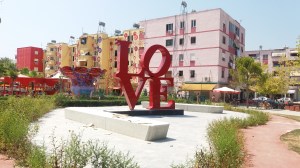
Cycle lanes. I remember while I was preparing for my DPSI exam a couple of years ago discussing the best way to say ‘cycle lane’, as it was something I had never come across in Albania. Now the centre of Lushnje has a cycle lane running right through it and, what is more, people were using it! In fact the whole of the central square has been made a no-car zone, and it’s lovely. (You can spot the red cycle lane in the photo above.)

Toffee apples. I associate these with frosty nights, Hallowe’en and bonfires, rather than with sultry Mediterranean evenings, but I don’t suppose there’s any good reason why Albania shouldn’t enjoy them just as much as we do. (I use ‘we’ in a generic sense – I hate fruit.)

Fried pizza. I thought this was purely a Scottish institution (served with chips, of course, because a deep-fried pizza doesn’t contain enough grease), but I suppose I shouldn’t really be surprised that such a delicacy also exists in Albania; they are awfully fond of frying things, often in gallons of oil.

I always seem to learn something new when I go to Albania, and usually not just about the cuisine. The rigmarole over the water supply in our house in Lushnje (two pumps in two different, locked locations, a valve on the roof and a stopcock half-buried in the yard – not fun) gave me a greater appreciation of the running water system we have here. In fact, our street might get proper running water before next summer, which would be wonderful!

I also learned to hold my possessions a bit more lightly. That’s already wearing off, since I live in a society where ownership is very clearly demarcated and closely guarded, but I do appreciate the Albanian willingness to lend and share, and not to care too much when something is lost or broken.

I was also reminded of the value of boredom. There’s a lot of waiting around in Albania; it’s just part of life. In the summer there are also times when it’s too hot to do anything, too hot even to sleep, so you just lie around. After a while, a bit of boredom opens up areas of your mind that lie dormant when you’re constantly busy or entertained, and that’s a good thing, especially if you work in a creative field. As well as getting on with the novel I’m working on (The Gates of Janus), I polished off a wee short story while I was there as well, which might not have happened if I didn’t have a lot of time just staring into the distance and dreaming.

So there’s your annual report on Albania. I can’t promise not to bore you about my budgie in future, but if you’re lucky something might occur to me that is interesting to a slightly wider audience 😉

A new decoration in Lushnje's park

The opposite of writer’s block

5 Sep

As usual I have to apologise for not writing  a new blog post for ages, but unusually the excuse is not just that I’ve been insanely busy (which I have) but also that I don’t know what to write about – or more accurately, I don’t know which thing to write about.

I have jotted down a few ideas for posts (I do this – I have an extremely rubbish working memory, so scraps of paper and memos on my phone serve as an alternative) but don’t want to write about all of them (if I wrote three posts in a week you might worry that I’d been replaced by the body snatchers!) and if I try to space them out over the next several weeks I’ll forget, or they will be out of date, or something else will come up.

So it’s over to you, patient readers who have just slogged your way through two one-sentence paragraphs. Do you want to read about my summer in Greece and Albania, with reflections on different culture, the changing face of Albania, and possibly language learning? Or would you prefer to hear about my beautiful new budgie, Gatsby? (I may become a bit of budgie bore, I’m afraid. He’s so cute!) Or would you like to hear about lactase? No, I’ll not tell you any more; if you’re intrigued, vote for it.

The survey should be showing below. (If it’s not, click here.) I look forward to getting my writing orders!

Rio’s Hug

10 Aug

This blog post is simply going to direct you to another blog post, on Premier Christianity‘s website. But no, I’m not being lazy, because I wrote that post too.

If you have seen the statue of Christ the Redeemer on your TV during the Olympics, and want to hear my musings about its significance, and how it connects to the Games, please do have a wee read:

Christ the Redeemer: Why Rio’s statue is the true God of the Olympics

2199847917_266917357b_b

Photo: Paul Mannix

The compassionate embrace includes everyone, from Olympic athletes to drug dealers, from top politicians to favela kids.

Are you a dangerous woman?

11 Jul

Did you know Cleopatra had a sister? Quite possibly you have never given it any thought, but in my research for the novel I’m working on (and which I will finish this year), The Gates of Janus, I have bumped up against Cleopatra’s younger sister, Arsinoe. She only turns up in the odd line in Strabo, Cassius Dio and Appian, but they are throwaway lines that are suggestive of a fascinating life that lies behind them.

So when I saw that the Dangerous Women Project was open for submissions, I thought I would really like to shed a bit of light on “The Other Ptolemy Girl“. (Yes, I totally lifted that title from Philippa Gregory.)

If you would like to learn a bit more about Cleopatra’s little sister, and how these siblings were both dangerous in their different ways (I’m glad I wasn’t born into that family), head over to the Dangerous Women site. The current submissions period is open until 7th August 2016, so if you have some views on dangerous women, too, why not submit your tuppenceworth as well?

Summer Sale and Author Interview

1 Jul

Smashwords is having its summer sale throughout the month of July, and my books Office Life (and Death) and A New Year’s Trio will be included, so you can read them for free! (If you haven’t already.)

Smashwords is an ebook shop where you can download books in all the normal ebook formats including mobi (for Kindle) and epub (for all other ereaders). Or you can just read them right there on your computer screen.

As part of the promotion they’re getting authors to do “interviews”, where we write the answers to various questions we are presented with. I’ve just done mine, so if you want to find out what my writing surface looks like (you’re dying to know, aren’t you?) or what my favourite book is, you can pop over and read the interview.

However, it’s not all about me: this is where you come in. If you want me to answer a question that is not covered in the author interview, let me know in the comments section below and I can easily add it in. 🙂

Julian of Norwich – not called Julian, probably not from Norwich

18 Jun

Juliana_of_NorwichMy Ten-Minute Guide to Julian of Norwich (the medieval mystic) is available in the July edition of Premier Christianity magazine, available at larger newsagents and online.

Obviously I couldn’t cover every aspect of her theology in a short article – although I could cover every known aspect of her life, since there are precious few of them. Anyway, if you want to learn more about the first (known) female English writer, and why she believed”all shall be well”, you could read her Revelations of Divine Love – or you could just cheat and read my article 😉

UPDATE: Now that I have received my copy, I see that my article on adult colouring books is also in the July edition. This means that I have written about 10% of the magazine this month, a fact that tickles me quite a bit 🙂

Why did the general cross the Rubicon?

4 Jun
alea 2

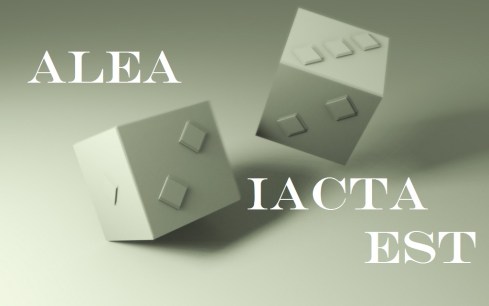
“The die is cast” – Julius Caesar’s words as he crossed the Rubicon

Recently (ok, not that recently – I’ve been busy) my cousin and fellow author posted on Facebook that a Rubicon had been crossed because he had taken his sunglasses out of the drawer. If you’re reading in a sunny country, understand that this is a bigger deal in Scotland. A friend of his replied to ask what on earth a Rubicon was, and I suppose the question was fair enough, because these days the name Rubicon is more likely to be used of tropical drinks than of a geographical feature in northern Italy.

The short answer to the Facebook question is that the Rubicon is a river, and crossing the Rubicon means passing a point of no return. Two minutes of googling can tell you the reason that crossing a Rubicon means passing a point of no return (and indeed the origin of “point of no return”, which is one of a surprising number of expressions from aviation), but as it’s an ancient history thing, I thought I might weigh in, albeit far too late and on a different media platform.

Thousands, probably millions of people have crossed the Rubicon, which is thought to be the river Fiumicino (meaning, imaginatively, “little river”), but the significant moment was when Caesar crossed it in 49BC. It was the start of something and the end of something, a definitive moment. It was in some ways like the shot that killed Franz Ferdinand. Months and years of manoeuvring to avoid a particular scenario, and then one action revealed how the manoeuvring had actually made that same scenario near inevitable. With Franz Ferdinand’s assassination it was the First World War; in Caesar’s case it was the end of the Roman Republic, leading to half a millennium of autocratic rule by emperors. (The Roman Republic was, you see, technically a democracy, although as in the case of Athens, “birthplace of democracy”, hardly anyone could vote, and at Rome it didn’t make that much difference when they did. Much like modern Western democracy. But I digress.)

The point about crossing the Rubicon was that it marked the boundary of Italy at that time. A general in command of an army was not allowed to just march his army into Italy, for obvious reasons of public safety and avoiding coups. If you raised an army in Italy, or brought one with you into Italy, you were revolting against Rome (except in particular circumstances which don’t apply in this case and which we won’t go into here). On the other side of the Rubicon (which was not a particularly formidable river, by the way, more of a brook – hence, Fiumicino) was Gaul, where Julius Caesar was quite legitimately commanding an army, for the purpose of attacking, killing and enslaving Gauls and Britons. That might not sound very nice if you were a Gaul or a Briton, but it was the sort of thing Rome heartily approved of.

So when Caesar crossed the Rubicon he went from being an astoundingly successful Roman general to leading a revolt against Rome, and there was no going back from that. Catiline had done something similar a decade and half earlier, and it had not ended well. But Catiline was in debt, accused of all sorts of crimes, and couldn’t get anywhere in politics, whereas Caesar was rich (from all the plunder), enjoyed legal immunity because of his military command, and was one of the two most powerful men in Rome. So the more interesting question is not “what does crossing the Rubicon mean” but “why did Caesar do it?”

To understand that you have to at least dip your toes into an extremely confusing period of history. I am currently writing a novel set during the Roman civil wars of the first century BC (The Gates of Janus), so believe me when I say it is fiendishly complicated. What follows is my attempt to make Caesar’s situation easily comprehensible without over-simplifying.

The three most powerful men in Rome around the middle of the first century BC were Julius Caesar, Pompey and Crassus, and in order to increase their power they had made an informal alliance, which we usually refer to as the First Triumvirate. Caesar was a brilliant general who was popular with the common people. Pompey was a brilliant general who was popular with the upper classes. Crassus wasn’t half the general they were, but he was staggeringly rich (we say “as rich as Croesus, but we could justifiably say “as rich as Crassus” instead), which made him popular with anyone who needed funds. This arrangement sort of worked and kept the power in Rome balanced between them, staving off the threat of dictatorship, which was what everyone was worried about (especially since current politicians had lived through Sulla’s dictatorship). Unfortunately Crassus died in a disastrous war with Parthia (Persia, more or less), and Pompey’s wife, who was also Caesar’s daughter, died in childbirth. Now there was nothing holding them together, and the Senate (like Parliament) was worried that one or both of them would try to seize sole power.

Supporters of Pompey (or those who thought Caesar was the bigger threat) pushed through a bill on bribery which would allow people to be prosecuted for offences committed up to twenty years earlier. There genuinely was a problem with bribery in Rome, so a new law about it wasn’t a bad thing, but the backdating made it dangerous for Caesar, who had spent much of the previous twenty years bribing people to get into the position of power he now enjoyed. Of course, that was the whole point of the law.

Caesar was protected as long as he was a general in command of an army, but in 49BC his period of command was coming to an end. Pompey’s wasn’t. Caesar expected to be elected consul (similar to Prime Minister) for the following year, which would also make him immune, but there would be a tricky interim period during which he could be prosecuted. Caesar applied to have his command extended until he took office as consul. He was refused; many senators thought he was already too dangerous, what with his army, wealth and popularity with both the troops and the mob. One of his supporters (Caesar had bought his support – seriously, bribery was big in Republican Rome) suggested that Pompey could lay down his command early, at the same time as Caesar, to even things up. Pompey said he would – but didn’t actually take any steps towards doing it.

Suddenly a rumour went around that Caesar had already entered Italy. Caesar’s bought man in the Senate assured them it was untrue, but the current consul ordered Pompey to gather an army to oppose him anyway. Caesar (still outside Italy) said he would give up most  of his his troops and territory, keeping just a little bit so he still had immunity. Pompey was happy with that, but the Senate refused. Finally Caesar said he would be willing to lay down his command at the same time as Pompey, but if Pompey kept his command, he would “avenge his country’s wrongs, and his own.”

By now, even though no blow had been struck, Caesar was officially at war with Rome. He was declared a public enemy, Pompey was declared the protector of Rome, and Caesar’s supporters were driven out of the Senate ‘for their own safety’. Even so, when he came to the Rubicon, he still paused. Yes, he was an enemy of Rome, and Pompey was gathering an army against him, but no blood had been shed yet, and politicians could change their minds; Caesar’s friend Mark Antony would later be declared a public enemy, but go on to rule half the Empire.

“If I stop here,” Caesar reportedly said, “it will be the beginning of misfortune for me; if I cross, it will be the beginning of misfortune for all mankind.” So, being as selfless as most military dictators (or for that matter, most people), he crossed.

The rest is history. But in case it’s history you’re unfamiliar with, here it is in a nutshell: Caesar wins and becomes sole ruler, but in a semi-constitutional way. Then he is assassinated, the Empire descends into full-scale civil war, and in the ensuing chaos Julius Caesar’s heir, Octavian, increases his power base and eliminates his rivals until he is supreme leader of Rome in a very unconstitutional way. By the time he dies he is the Emperor Augustus, founder of a new dynasty.

So that’s why crossing the Rubicon is a big deal, much like breaking the summer clothing out in Scotland. By the way, an interesting fact that I discovered when doing some research for this post (yes, I do carry out research for blog posts – is that so surprising?) is that Rubicon tropical drinks are also named after Caesar’s crossing. The founders of the company left their secure jobs to start the venture, and there was no going back. Caesar may have been a dangerous man, but he had a sense of humour; I like to think he wouldn’t mind having a can of guava juice named after the most momentous decision of his career.

Good Friday Thoughts

25 Mar

Good Friday is an odd one. It’s very solemn and sombre for Christians because we’re essentially pretending (by way of memorial) that Jesus is dead, even though we know that he has been risen for some time now. It’s an opportunity for ecumenical events (meaning joint with different kinds of churches), during which people tiptoe awkwardly around the fact that they know very little of their companions’ practice of faith or the vocabulary that accompanies it (communion/Eucharist/mass/Lord’s Supper; priest and clergy vs minister and leadership team etc.), even though it’s the same faith they’re practising. At post-service snacks, some enthusiastically scoff hot cross buns while others, who are fasting, quietly don’t. A strange time, but a bit of disorientation can be good to snap you out of your usual life and help you remember what this Easter lark is all about, anyway (and it’s not chocolate bunnies or the Babylonian goddess Ishtar, as a historically and etymologically illiterate Facebook meme would have us believe).

It’s an even stranger one than usual this year, because Good Friday (the memorial of the crucifixion) lands on the same day as the memorial of the Annunciation (when the angel announced to Mary that she would give birth to Jesus), meaning that (if you’re in a church that takes note of these things) we’re celebrating Jesus’ arrival as a baby whilst also mourning his death. I had only recently found out about the tradition that the Annunciation and the crucifixion were both on 25th March (to keep things nice and neat), so it’s quite serendipitous for me that in the year I find this out, the memorial of the crucifixion (which depends on the lunar calendar, thus a literally moveable feast) falls on the anniversary.

(There’s also a superstition that their coincidence is supposed to presage national disaster, such as the death of a monarch. Given how many famous people have already died in 2016, that wouldn’t be terribly surprising – but let’s hope it’s only as true as superstition usually is.)

Anyway, the article that drew my attention to this nice syncronicity is very well written and interesting, with lots of lovely pictures and (if you keep going to the end) a brilliant poem by John Donne called, rather unimaginatively, Upon the Annunciation and the Passion Falling upon One Day – so I will simply link to it so that you can enjoy it:

This doubtful day of feast or fast – Clerk of Oxford

Happy Easter!

Happy St Patrick’s Day!

17 Mar

I don’t usually observe St Patrick’s Day, not being Irish, but I feel that I should pay a bit more attention to it this year, since this is the first 17th March since my book Patrick: The Boy Who Forgave came out.

It’s actually tomorrow that I’m doing something for St Patrick’s Day / week – giving a talk about the historical St Patrick. It will be an invigorating jog through ancient history, if you like that sort of thing, and if you don’t like that sort of thing, at least it will be short and free. It’s at the Govanhill Neighbourhood Centre at 7pm, and I’ll be available for book sales and chat afterwards. There may even be a post-talk sojourn to a drinking establishment, if one can be found. And while Pat himself might not have approved of that, I am led to believe it is traditional at this time of year 😉