Foreign Encounters Released

25 Oct

Foreign EncountersThe Writers Abroad anthology Foreign Encounters has been released. I have a short piece in it called “Sounion”, which is rather good and atmospheric if I say so myself.

Foreign Encounters is available from Lulu as a paperback for £7.44 ($9.99, hence the strange UK price), and profits go the the charity Books Abroad which provides school books to poor countries.

The anthology will probably come out as an ebook at some point, too, if you prefer your books that way.

The Consolations of Growing Up

23 Oct

Last week I unwisely finished reading The Graveyard Book by Neil Gaiman shortly after watching the end of Peter Pan (2003) on TV. Both of them have bittersweet endings involving the hero or heroine growing up and leaving behind friends or family who are unable to join them – either because they are ghosts (in the case of The Graveyard Book) or because they are Peter Pan, and have vowed never to grow up. Both of them left me in tears – although, to be fair to myself, I had been working rather hard, feeling stressed and staying up too late, which can make anything seem worth crying about.

Absorbed in quick succession these works can leave you feeling that “to grow up is such a barbarous business”, that growing older is not just a tragedy but also some kind of failure, as if every year you allow to slip by is a betrayal of the happiness of your youth. For me personally it doesn’t help that I’m approaching a milestone. Not that this is your average milestone, mind you. I’m not turning thirty or having a child or anything, but I will soon be older than Alexander the Great ever was. That probably means nothing to you but I’ve idolised him since I was 17, and now that I’m about to outlive him (barring accident), it’s impossible not to notice that he achieved more with his life by this point than I have.

Fortunately, I have an excellent antidote to all this morose calendar-watching. I am currently studying the life of St Augustine, another towering figure from antiquity who, like Alexander, suffers a lot of misunderstanding and bad press. Unlike Alexander, though, Augustine spent quite a lot of his youth faffing around, getting into trouble and wondering what it all means. It wasn’t until he was about the age that Alexander died (incidentally also about the same age that Jesus died – a strangely significant age, apparently) that he surrendered to God, pulled himself together, and made something of his hitherto pointless life. He went on to write some of the greatest works of Christian literature and to use his remarkable rhetorical powers trying to bring unity to the church and godliness to people’s lives. He lived to be 75.

Most of us don’t achieve that much with our early lives. Although there are always exceptions, like Alexander the Great, Pitt the Younger and Premiership footballers, most of us are just getting started by the time we’re thirty – which is fine, because there’s a lot of life still to come. In fact, much as we may look back with fondness on the “blue remembered hills” of our childhoods, we tend to get better at almost everything with age. Adults are more skillful than kids. I find I can knit better than I could as a child, translating Latin has mysteriously become easier (although it’s still extremely hard), and don’t even get me started on child actors or (shudder) children singing.

In fact, it’s not even clear if the sadness in Peter Pan is that Wendy must grow up, or that Peter never will. Their separation is caused by the combination of those two factors, not by one or the other. So I will be sad to overtake Alexander and leave him behind me, eternally youthful, but perhaps more for his sake than mine. After all, getting older might sometimes be pants, but it’s better than the alternative.

Trendy Tots

4 Oct

Yesterday I saw a beautiful dress. It was a lilac-grey jumper dress with bands of lace. It’s very on-trend and would probably suit me. Normally if I really liked an item I would ask the wearer where she got it, but in this case the wearer was my one-year-old niece. Even if she was able to tell me what shop it was from, they probably wouldn’t do it in my size.

I am not the only one who has noticed the astonishing change in baby clothes since I was a baby myself. I don’t actually remember what I wore as a baby, of course, but going by things I remember wearing as a small child – hand-knitted jumpers and cardigans, dungarees, endless hand-me-downs – I don’t think that I was being wheeled around in my pram in brand-name jeans.

These days kids have a much bigger range of clothes to choose from, although they are not usually the ones doing the choosing. It’s not just my niece. The new pastor’s son (aged one) looks the epitome of cool in his jeans and hoodies, while my nephew (also aged one) could easily swap clothes with my husband (not aged one) without anyone noticing anything amiss, apart from the difference in size. (Truth be told, there’s not that much difference in size, actually; my nephew is huge for his age.) I’ve even seen a tiny girl on the train with a top-end brand-name scarf (I think it was Prada), which just seems silly. Surely Asda tastes just as good as Prada?

It’s easy to disapprove of the money wasted on these clothes, particularly the expensive brands, when the kids will only grow out of them, but while there’s logic in this, I think there’s also a bit of jealousy. “We had to wear scratchy, hand-me-down woolens, how come they get Next dresses with cute stripy tights? Let them suffer too!” Not a very attractive, or very fair attitude. Some of the new baby clothes aren’t any more expensive than the ones we wore, anyway, it’s just that manufacturers make them in line with adult fashions now, which for some reason they never used to. And a major point in their favour is how cute the kids look in them. Grown women squeal and sigh over my niece’s wardrobe, and how adorable it makes her look. (Not that she wouldn’t look adorable anyway. She is related to me, after all.;))

On balance I think I like the trend for trendy tots. Their baby photos will be less embarrassing to them in the future, and in the meantime it’s fun to dress them nicely. There’s just one thing that would make my approval complete: an enlarging machine, like on Honey I Blew Up the Baby, so I can have the lacy dress when my niece has finished with it.

Are you Average?

19 Sep

While doing the washing up this morning I became aware of the warm, damp, clammy sensation that tells me that another rubber glove has sprung a leak. It was the right-hand glove, of course; it’s always the right glove. (I’m right-handed.) This time it was sort of my own fault since I had bought a very cheap variety. It lasted about three days and then split between the thumb and index finger because it was cheap and nasty, and if it had come in a pack of 50 instead of a pack of two you would have assumed it was disposable. It is now.

Usually, however, it’s at the tips of the fingers that rubber gloves break, because that’s where there’s a loose bit, and it is about this that I wish to moan: why do rubber gloves only come in medium?

I understand, of course, that not all products can be produced in a variety of shapes and sizes to suit every customer. It wouldn’t make economic sense. So, you would think medium was a fairly sensible size to bring rubber gloves out in, if limited to one size. Not so. “Medium” seems to refer to the size that fits the average human hand – not the average female human hand. Call me sexist, but in my experience women do the vast majority of work that calls for rubber gloves, from washing dishes to scrubbing floors to cleaning toilets. So why bring the gloves out only in a size that is too large for most women? I do not have petite little mitts, but I am left with quarter of an inch of useless rubber at the end, preventing me from picking small things up and getting itself caught when I try to clean things. And then breaking, so I have to buy more medium-sized rubber gloves.

Now, it is not strictly true that rubber gloves only come in medium. I have also seen them in large. Large! Why large? A size that doesn’t fit most women complemented by a size that fits no women. I have no objection to men wearing rubber gloves (especially if it means they’re doing the housework) but why can’t rubber gloves come in small and medium, or small and large if need be? Why can’t I have a pair of rubber gloves that fits me, and therefore won’t break at the fingertips after a few days or, at most, weeks of wear?

Admittedly there must be places that you can get small rubber gloves. I haven’t explored all avenues. But frankly I don’t want to go to specialist shops or pay postage just so I can do the washing up in comfort. As I see it, barring specialists, I have three alternatives. The first is to buy those latex, single-use gloves that come in a variety of sizes, making life easier but costing more money and helping to destroy the environment. The second is to grow very long finger nails. This would mean that my fingers would reach to the end of the medium-sized gloves, although I don’t really think that having long, sharp tips to my fingers would help with the problem of rubber gloves splitting. Thirdly, I can just buy another pair of medium gloves that don’t fit and will soon break, while muttering under my breath, and relieve my feelings by writing a blog post about it.

Can you guess which I will choose?

Understanding Karenina

11 Sep

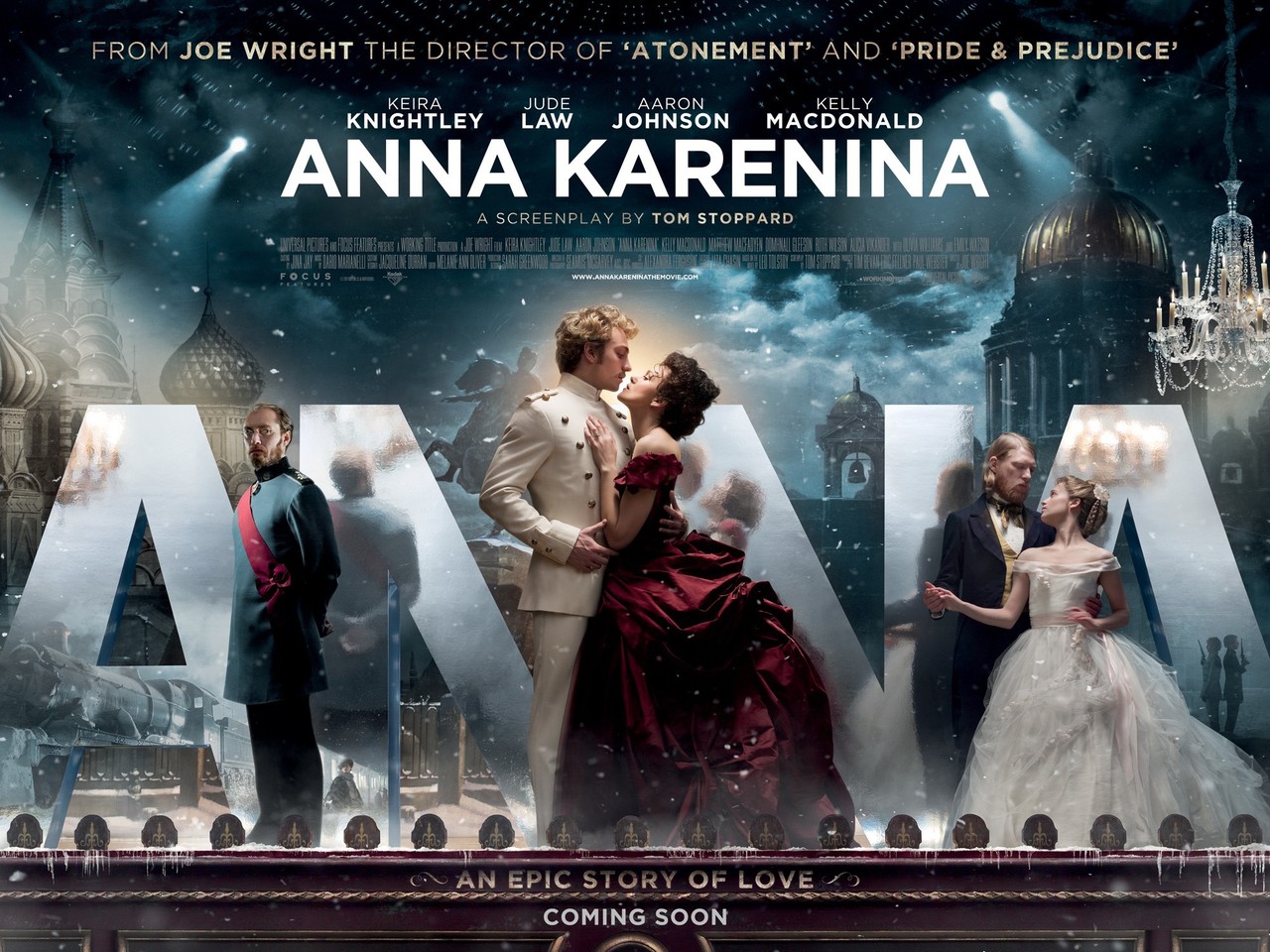
Last night I went to see the new film of Anna Karenina, adapted by Tom Stoppard. I had read the novel, but it was a good few years ago and going into the film I was carrying around the thought that Kitty was “young” and Anna was “old” – not old old, of course, not in need of a walking frame, but middle-aged. After seeing the film, and through it remembering the book, I realise that I was wrong. Anna is not old, even though Kitty is a good decade younger. She has been married for many years, yes, but she was only 18 when she got married. What Anna is, is an Older Young Person.

I use that phrase as if it’s an official description because, at my church, I sometimes put on events for Older Young People. It’s a category that’s not well-defined, but which I fall into myself. At the lower end it includes people who really are very young, in their early twenties, but who are no longer students and have therefore outgrown the previous stage of their life and been replaced by new models rolling in for Freshers’ Week. At the top end are those who have proper jobs and houses and so on, and have had for some time, but still sometimes feel like they’re not ‘proper’ grown-ups; people who notice, with incomprehension, that there are folk ten or fifteen years younger than themselves who can drive, marry, drink alcohol, seek gainful employment (though finding it is rarer these days), and in most other ways appear to be functioning adults. We are still young, but no longer obscenely young. This is the Older Young Person.

Now that I am a few years older than I was when I read the novel, I understand Anna a lot better. She didn’t want to hurt Kitty, of course, and even felt protective of her, but the ability to turn Vronsky’s head when that part of her life was supposed to be behind her was intoxicating. It wasn’t just Vronsky’s good looks and charm that tempted her, it was being seen as an attractive woman in her own right, not someone’s wife or mother or aunt. The kind of person who might dance at a ball. The kind of person who might embark on a love affair. A young person.

I don’t have to cope with a stale marriage, nor have I ever found myself infatuated by another man since I met my husband (for which I thank God), but for all that I know a little of what Anna was going through. She was beautiful, may even have become more beautiful with age, but she had lost the dewy glow of youth that Kitty brandished so innocently, and no amount of BB cream can ever give you that back. She had made her choices, and they were good ones, but the thrill of having life choices to make is so much more exciting than the satisfaction of having made them. Kitty’s rival was another woman, but Anna’s rival was time itself, and that’s a much scarier adversary, because he always wins in the end.

I’m rather pleased (and not a little surprised) that the new film does leave in all the moral censure that gives the story of Anna Karenina its point; what Anna does is understandable, but like many understandable things it’s also very wrong. So while I may look in horror at the dates of birth of some of my younger friends (how can someone born in the 90s even tie their own shoelaces yet?), I won’t be embarking on a torrid affair with a young cavalry officer. Instead, I will invite my Older Young friends round for dinner and laughs. And refuse to tell anybody under 25 my age.

A Life Less Ordinand

6 Sep

Last weekend I was involved in the induction and ordination of the new pastor-cum-chaplain at my church. Events like this always make me irrationally nervous. I’m afraid I might stray onto the stage at the wrong moment and accidentally become a priest or something.

It was the first ordination I had ever been to, but it was similar to a lot of other formal ceremonies of that type, like a mixture between a christening, graduation, wedding and funeral – all the stages of life, really. It began with a minister speaking the words “We are gathered here together…” like a wedding, involved promises from the congregation like a christening or child dedication, had a eulogy like a funeral (much weirder when the man is sitting listening to how wonderful he is), and, just like a graduation, there was a moment when the ordinand (person to be ordained) knelt down as one thing and rose up as another, going from layman to minister the way a student goes from graduant to graduate in a few seconds.

Actually, it was a lot more than a few seconds at the ordination, because the poor man had numerous prayers spoken over him while he was kneeling on what looked like a very uncomfortable step. By enduring that he has already demonstrated a significant committment to his calling. At my graduation from St Andrews it was far, far grander of course (it was all in Latin, for a start) but it was over very fast; a quick tap on the head with John Knox’s breeches while the Chancellor said the secret magic words (“et super te” – or Superted, if you prefer), and you get up a Master of Arts (in my case), then shuffle off into the wide, cruel world.

The ordination and induction is the opposite of that, really. It marks the start of something, not the end, and while it involved the new pastor saying goodbye to his old church (most of whom seemed to be present – the place was heaving) he won’t be leaving behind all of the people who were at the ceremony. In fact he will be working very closely with some of us in a new, exciting and sometimes rather daunting project – being the minister of a church while simultaneously supporting, as a chaplain, the business community that surrounds the church.

I was glad when the ceremony was over, not only because of the amazing buffet (tables groaning with salmon, prawns, cous cous, pasta salad, potato salad and any number of cakes) but also because, as I said, these things make me unpleasantly nervous. Now we can look forward to the unknown and exciting future of our church, about which I’m also nervous, of course, but it’s a much nicer variety of nervousness.

The Trials of Dyslexia

23 Aug

An hour or so ago I was idly considering whether, if there were a cure for dyslexia, I would take it. I’ve blogged about the joys of dyslexia before, but there are drawbacks, of course. In fact, it’s mainly a drawback, otherwise it wouldn’t be termed a specific learning disability (or whatever they’re calling it this week). This was brought home to me once again, very soon after my ponderings. I am currently supposed to be at an AGM but I forgot to leave something my husband needed before I departed, forgot my phone so I couldn’t even tell him, and so had to come home and miss my train. No AGM.

Forgetfulness isn’t exclusive to dyslexia, of course, and I don’t have conclusive proof that it’s even connected to my dyslexia, but I’m pretty sure it is. Dyslexia is a range of problems arising from faulty brain wiring (a rough description), mostly to do with reading and writing, hence the name dys – with difficulty, faulty; lexis – speech. These specific problems are usually associated with other ones, though, like clumsiness, forgetfulness and even difficulty following the plots of films (I kid you not). I have no difficulty with film plots, but I am forgetful, and my clumsiness drives me up (and very often into) the wall.

So why isn’t it an easy decision to choose a hypothetical cure for dyslexia? No more smashed glasses and chipped dishes, no more missed appointments. With a working sense of spatial awareness I might even be able to dance enthusiastically without the risk of knocking out anyone who came too close! If there were a cure for my lung diseases (two for the price of one) I would snap it up. If hayfever could be permanently cured I would take the injection or have the operation. There is a cure for short-sightedness, and I’ve had it: Thank you, Ultralase, I can now see. So why not dyslexia?

The thing is that dyslexia feels much more a part of me than any of these other conditions. Take away the sniffliness or the need to use an inhaler and I would be exactly the same person. My eyesight was bat-like, now it’s eagle-like, but it doesn’t affect who I am. If you changed the functioning of my brain, though, would that still be true? Who knows how many of the traits I think of as my own are in some way connected to being dyslexic? How much of who I am has been shaped by struggling with this range of problems, and how much of me would change if I didn’t have to struggle? If there were a way to try out a non-dyslexic life without committing to it, maybe that would be an option. But would the non-dyslexic me who made the final choice really be me, or would she make a different decision because she thought differently once she was eulexic? (No, that’s not a real word.)

Ok, this is getting excessively philosophical and could go on forever, but you see my point: It’s not a decision to take lightly. For the moment it’s purely theoretical and I can just sit on the fence, but if it ever became a real possibility, what would I choose? I honestly don’t know.

An Ex-Ex-Pat Writes…

14 Aug

Foreign Flavours, the anthology from Writers Abroad, is now available on Kindle. All the contributors either were or are ex-pats. I Foreign Flavours Anthologyused to live in Albania, and my piece in the anthology is about Turkish coffee. It’s part recipe, part cultural and historical introduction to Albania.

I just heard today that I will have a piece in the new Writers Abroad anthology, too. The anthology will be called Foreign Encounters, and will take the theme of relationships around the world. My contribution is a non-fiction piece is called “Sounion”, which features a bit of Greek mythology. Look out for it in October.

Scots, Scottish English and Scottishness

11 Aug

I really ought to be studying Latin just now (I’m trying to get my Latin A-level. It’s a long story.) but instead I find myself thinking about Scots. Scots is what we in Scotland call our language. It sometimes gets called “the Scottish dialect”, since it is a branch of English, but it’s actually (if you want to get technical) a national language variant rather than a dialect. Anyway, what it’s called is not really the point, the important thing is what it contains, in terms of language, and who uses it.

What set me off thinking in this vein was the Pollok Park Family Day last Saturday. There were lots of animals in a big muddy field (it was a lot better than that makes it sound), and commentating on the various animals and activities was a Scottish man. That’s hardly surprising, as Pollok Park is in Glasgow. (It is a very impressive country park, incidentally, and home to the Burrell Collection amongst other things.)

This Scottish man used lots of Scottish words – muckle, clatty, that sort of thing. The problem was that they didn’t sound natural. He sounded as if he had a list of “Authentic Scottish Words for Speakers at Scottish Events” and he was determined to squeeze in as many as he could. It left me feeling a bit ambivalent. I don’t want these words to die out, and they will if the younger generation doesn’t hear them, but then what’s the point in having them if they’re only party pieces, words that you have to go out of your way to use, and pat yourself on the back when you do?

A lot of people still do use Scots words, including those who don’t realise they do. People in the rougher parts of Glasgow could never be mistaken for speakers of the Queen’s English, but at the upper end of the Scots spectrum is something sometimes known as Scottish English, which is what they speak in the Holyrood (the Parliament) and what you find in business letters here. Most Scottish people would think it was just English with a Scottish accent, except that there’s the odd wee difference that you would only notice if you weren’t Scottish, such as the word “outwith”: Perfectly acceptable and rather formal within Scotland, but unfamiliar outwith it.

A better example of how Scots can work as a modern language is found, rather surprisingly, in the Disney film Brave. It’s set in some unspecified medieval period, but the people speak more or less modern Scots. Not the full-on, Rabbie Burns version, but it features plenty of vocabulary, and even grammar, that isn’t found in standard English. (I did enjoy the line “[A princess] disnae stuff her gob!”) It doesn’t all ring true, but the vast majority of it does, probably because the actors are actually Scottish. And there’s a wee gem in the film for Scottish language enthusiasts – a lad who speaks Doric (the dialect of the North East) and is completely unintelligible to the rest of the folks speaking ‘standard’ Scots.

Of course, the reason I take such an interest in the subject is that I don’t really speak Scots myself. I lived in England for many formative years, and although I can understand Scots (except Doric – no-one understands that), speaking it comes about as naturally to me as the pointedly Scottish words did to the MC at Pollok Park. I, therefore, will not be much use in preserving the language except as a semi-external observer. But then, as Rabbie said, isn’t one of the greatest gifts “tae see oursels as ithers see us”?

Front Page Fame

4 Aug

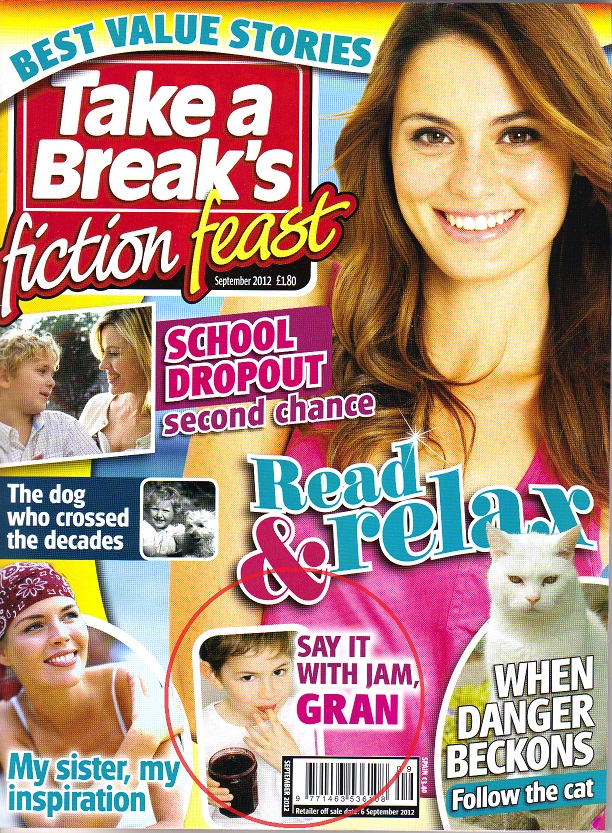
TAB Fiction Feast Sep 2012This month’s Take a Break’s Fiction Feast contains my short story “In a Jam”. It’s a bit of a tear-jerker about a woman becoming reconciled to her estranged mother through her young son’s love of Granny’s jam. You’ll find it on page 35, and it’s also featured on the front cover.

TAB Fiction Feast is priced £1.80 and is available in larger newsagents.

If you like this, you’ll probably also like the free short story “Running for Cover” (and vice versa). Jayne S has been kind enough to provide a lovely, and very well-written review of “Running for Cover”.